What Is an Agent Harness? Why AI Agents Need a Structural Framework to Function

Right now, almost everyone talking about AI agents fixates on one thing: the model itself. You'll hear endless discussions about reasoning capabilities, context windows, and benchmark scores. But here's what becomes obvious the moment you start building systems that actually execute complex multi-step tasks — the model is only half the equation.
At its core, a language model does one thing: predict the next token. It has no idea how to manage extended workflows. It lacks persistent memory. It can't access a terminal on its own. It can't recover gracefully when things break. For AI to function as a true working agent, you need something more — an entire layer of orchestration surrounding that model. That layer has a name now: the agent harness.
The term gained real traction after Mitchell Hashimoto introduced "harness engineering" in an early 2026 blog post. His core insight was refreshingly simple: instead of trying to make models smarter, design the operating environment so AI fails less often in the first place. Within weeks, platforms like LangChain, OpenAI, and other agent frameworks started using similar terminology to describe this infrastructure layer wrapping the model.
Article Contents
Understanding Agent Harness Fundamentals
There's a saying making the rounds in AI circles: "If it's not the model, it's the harness." That phrase actually captures something quite accurate about how modern agents work.
An agent harness is the complete software layer surrounding a language model. It provides the working environment, memory systems, available tools, orchestration mechanisms, and safety controls. If the model is the "brain," the harness is what lets that brain interact with the real world.
This is why the modern AI agent formula looks like: Agent = Model + Harness
The model handles reasoning and generates outputs. The harness transforms that reasoning into actual action.
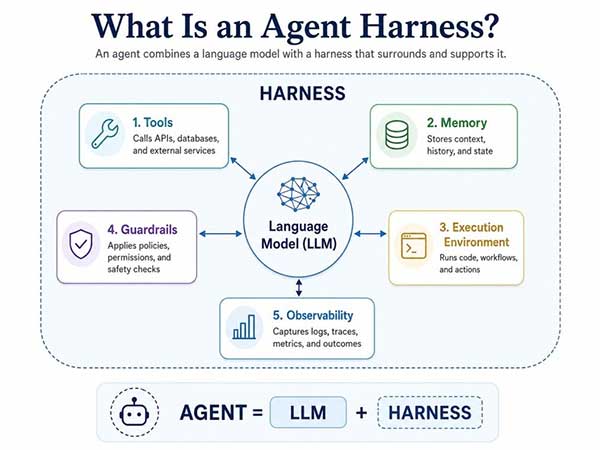
Terminology isn't perfectly standardized yet — some platforms use words like scaffold, runtime, or framework to describe overlapping concepts. But regardless of naming, the underlying idea stays consistent: an AI agent isn't just a model. It's an entire system of operations around that model.
Why Raw Models Aren't Enough for AI Agents
A raw language model might generate decent code. But that doesn't mean it can run a complete workflow by itself.
Say you ask AI to fix a bug in a Python project. The model can produce code that "looks right." But the model has no idea how to open the project, run test suites, read error logs, edit files, and re-run tests until the problem vanishes.
Add a proper harness, and suddenly this becomes a real workflow. The AI can read the filesystem, execute terminal commands, check output, modify code, and iterate until the task is complete.
That's exactly why sophisticated coding agents like Claude Code depend so heavily on harness engineering, not just raw model power.
What's interesting here is that even Anthropic recommends starting with the simplest possible system and only adding complexity when the workflow actually demands it. That suggests harness itself can become a source of problems if it's over-engineered.
Core Components of an Agent Harness
System Prompts and Behavioral Rules
Most AI agents today manage baseline behavior entirely through the harness layer.
This includes system prompts, coding standards, project conventions, role constraints, and safety policies. In modern coding agents, a file like AGENTS.md might specify naming conventions, coding style, or what actions the AI can even attempt within the project.
A trending approach in 2026 is "progressive disclosure." Instead of dumping every tool's full documentation into context upfront, the harness shows only a brief summary. When AI actually needs a specific tool, detailed instructions load on demand.
This approach dramatically saves context window space and cuts unnecessary token consumption.
Tool Systems: How AI Interacts With the Real World
What separates an AI agent from a chatbot is tool access. Through a harness, AI can read and write files, execute terminal commands, call APIs, query databases, search the web, and even control browsers. The harness also manages which tools are available, when AI can use them, and how results get formatted before returning to the model.
MCP (Model Context Protocol) is becoming the standard for tool connections in 2026. Platforms like Anthropic Agent SDK, LangChain Deep Agents, and OpenAI Agents SDK all support MCP, letting AI connect to external tool servers without custom integration work for every single tool.
This matters because it means the AI agent ecosystem can become flexible instead of each platform building isolated tool systems.
Memory and State Management
An AI agent can't function long-term without memory. The harness typically manages conversation history, execution logs, user preferences, summaries, and current workflow state. This becomes critical for agents running for hours or days continuously.
Imagine an AI processing a long workflow but hitting a restart mid-way. The harness needs to know which tasks finished, which are still pending, and the current system state so the agent resumes work instead of starting completely over.
Some modern harnesses even auto-summarize long histories into compact summaries to prevent context windows from ballooning. Without this memory layer, an agent would constantly "forget" what it was working on.
Execution Environments: Where Work Actually Happens
Many people assume a powerful model is all you need. The reality is different. AI also needs an actual execution environment to take action.
This could be a filesystem, sandboxed terminal, browser instance, container, or cloud runtime. Without an execution environment, the AI just talks about work — it can't actually do anything.
The current trend favors isolated sandbox containers — temporary environments created for each session and destroyed when the task ends. This prevents dependencies, packages, and network calls from different workflows interfering with each other.
This architecture is why modern AI coding agents can run code reasonably safely without destroying the host system.
When workflows get complex, a single model often isn't enough. Many systems now split tasks across multiple specialized sub-agents. One agent researches, another writes code, a third reviews results, and a final agent synthesizes everything. The harness orchestrates this entire multi-agent workflow.
LangChain Deep Agents exemplify this: they break large goals into smaller steps, spawn specialized sub-agents for each task, then return only the final summary to the main agent. This multi-agent orchestration is shaping the future of agentic AI.
Guardrails and Permissions Are No Longer Optional
Once AI can edit files, run code, or access real data, permission layers become essential.
The harness now typically enforces permission checks, requires human approval for sensitive actions, blocks dangerous operations, and validates outputs before AI executes critical tasks.
For example, AI might read files but not push to git. Or generate SQL but never query production databases directly.
This safety layer is absolutely critical when deploying AI into actual business workflows instead of just controlled demo environments.
Observability and Tracing for AI Debugging
A real AI agent might execute dozens or hundreds of steps continuously. If something breaks at step 47, developers need to know exactly what happened.
That's why observability and tracing are becoming standard in modern harnesses. Tracing logs every model call, tool invocation, handoff, latency measurement, token count, cost, and error throughout the workflow. Systems like LangSmith, OpenAI tracing, and OpenTelemetry are becoming the new debugging standard for AI agents.
The real concern is that as AI agents become more like actual software, they need traditional software monitoring and debugging tools.
Harness vs. Framework vs. Runtime: What's the Difference?
This is probably the most confusing part right now because these boundaries are still shifting.
Frameworks provide building blocks so developers can construct agents. Runtimes focus on durable execution, retries, state persistence, and long-running workflows. Harnesses operate at a higher level — they don't just provide components. They include planning, filesystem access, context management, sandboxing, orchestration, and a nearly complete policy layer.
Here's a useful analogy: if Node.js is a runtime and Express is a framework, a harness is more like Next.js — a system with many design decisions already made, not just basic components.
Real-World Applications: Coding, Research, Data, and Enterprise
The basic components appear across many different use cases. But how they combine matters enormously. A coding agent and an enterprise workflow agent both need a harness, but they emphasize different aspects. These categories aren't official standards — they're practical ways to see how one core idea adapts to specific work.
Harnesses for Programming Agents
Coding agents are the most visible example right now because their harnesses are so obvious. To work effectively, programming agents need file access, git context, terminal execution, test running, dependency installation, and project rule compliance. Claude Code and Codex are textbook examples — both rely heavily on substantial harness code, not just pure model APIs.
The difference between a good coding harness and an average one usually lies in small details: how the system recovers from failed tests, how it handles rollbacks after bad edits, or how cleanly it presents git history to the model. These details consume most engineering effort.
For a concrete example, DeepSeek's harness pushed the "everything is a plugin" concept to its limits.
Harnesses for Research Agents
Research agents need a different toolkit: web search, source tracking, note-taking, citation management, and content summarization. The harness manages how search results get stored, how sources are attributed, and how long documents get split and processed to avoid exhausting context in a single pass.
Harnesses for Data Analysis Agents
Data agents need access to datasets, SQL databases, Python execution environments, and schema information describing available tables and columns before writing queries. The harness also enforces permission restrictions — extremely important when agents operate on production data.
Harnesses for Enterprise Workflows
Enterprise deployment adds another layer of requirements: authentication, audit logging, approval workflows, role-based access control, and integration with internal systems. AWS AgentCore exemplifies this category with identity management, VPC networking, and observability features. Microsoft Agent Framework addresses similar needs for teams in Azure or .NET environments.
Why Harness Architecture Is Becoming the New Battleground
Early generative AI was all about the model race. Whose model was smarter? Who had longer context? Who scored highest on benchmarks? That's still important. But as AI shifts from chatbot to agentic systems, the harness layer is becoming equally critical.
A modern AI agent needs more than raw reasoning. It needs tool systems, memory, execution environments, orchestration, permission layers, and full observability to run reliably in production.
The model is the brain. But the harness is what transforms AI from a talking system into something that actually accomplishes real work. In a few years, choosing the right harness might matter as much as choosing the right model.
Description: Explore agent harness architecture, why language models alone can't power autonomous agents, and how this infrastructure layer is reshaping AI develop
Related Articles
- Create a National Day Celebration Video: A Step-by-Step Guide
- How to Continuously Improve Your AI Agent's Performance
- Windsurf vs Cursor: Which AI IDE Should You Choose?
- Best AI Tools for Microsoft Excel in 2026: Data Analysis, Formulas & Charts
- The Upload Button Paradox: How AI Tools Became Your Company's Biggest Security Risk

No Comment to " What Is an Agent Harness? Why AI Agents Need a Structural Framework to Function "