Claude Science: Anthropic's AI Platform Built for Research Labs
Anthropic just rolled out Claude Science, a purpose-built AI platform designed to streamline computational research for scientists. Instead of juggling multiple databases, workflows, and tools, researchers now have a unified environment where they can focus on their actual work. This is Anthropic's latest move to own entire vertical workflows — not just sell language models.
What exactly is Claude Science?
First, let's clear up what Claude Science actually is. Anthropic is straightforward about this: "It's not a new AI model, and it's not a beefed-up version for biology. It runs the same Claude models available to everyone (including Claude 3.5 Sonnet), requires no special access, and has zero restrictions."
The platform builds on Claude for Life Sciences, which Anthropic launched in October 2025 — essentially an upgraded version of Claude that performs better on scientific tasks. Claude Science takes that capability and wraps it in a dedicated workspace for scientists to actually get work done.
This launch signals something bigger about Anthropic's strategy. The company isn't content being just another model provider. It wants to own the operational layer for entire industries — think how Claude Code became the operating layer for software development. Anthropic is betting hard on vertical products that manage workflows, not just raw model performance. That's a fundamentally different way to compete and price against rivals.
How Claude Science works
A primary AI assistant acts as project manager for your research. It connects to over 60 scientific databases and comes with pre-built toolsets for specific fields: gene research, protein structures, chemistry. This main assistant can spawn sub-agents to divide labor — like a project lead handing tasks to specialists — or delegate to custom "specialist" assistants you've built for your own research. Then a separate validation agent double-checks citations and calculations before anything gets published.
That fact-checking step matters. A lot of AI-assisted papers lately have fake citations and unverifiable statistics slipping through. The thing is, it's still the same base model checking itself, not an independent fact-checking source you can trust. What's interesting here is that Anthropic knows this and is transparent about the limitation.
Anthropic says Claude Science has other built-in reproducibility features. For example, when it generates images — 3D protein structures, chemical diagrams — it also outputs the exact code that created them. Each visualization includes "the precise code and execution environment that generated it, described in plain language about how it was made, plus the entire conversation history," according to the company. This saves scientists time because they can edit images using natural language commands, and the system automatically updates the underlying code accordingly.
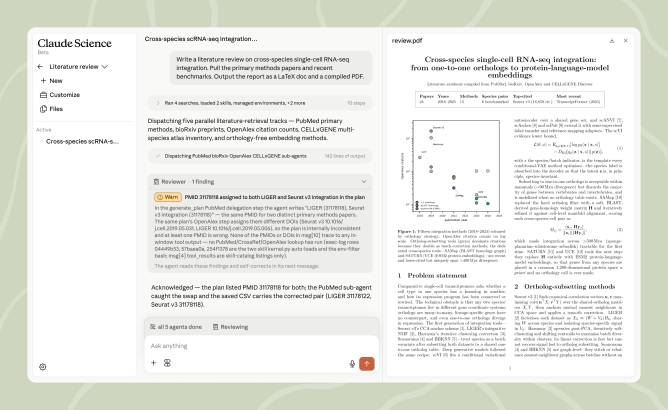
Claude Science generates rich scientific outputs that are completely reproducible. Scientific research is visual by nature, so Claude Science creates illustrations and diagrams alongside the code that generates them. The system can display diverse scientific products directly: 3D protein structures, genomic browser data, chemical structures, and more. You can chat with the AI agent about any detail and annotate images or diagrams on the fly, helping the AI understand exactly what needs refining before your document is publication-ready.
When Claude Science creates a visualization, it supplies the exact code and execution environment, plus a natural-language explanation of the process and your full conversation history. This means you can track your inputs and verify or reproduce results months later without losing context. Need to remove gridlines or switch to a logarithmic scale? Just ask Claude Science in plain English, and it automatically adjusts the code.
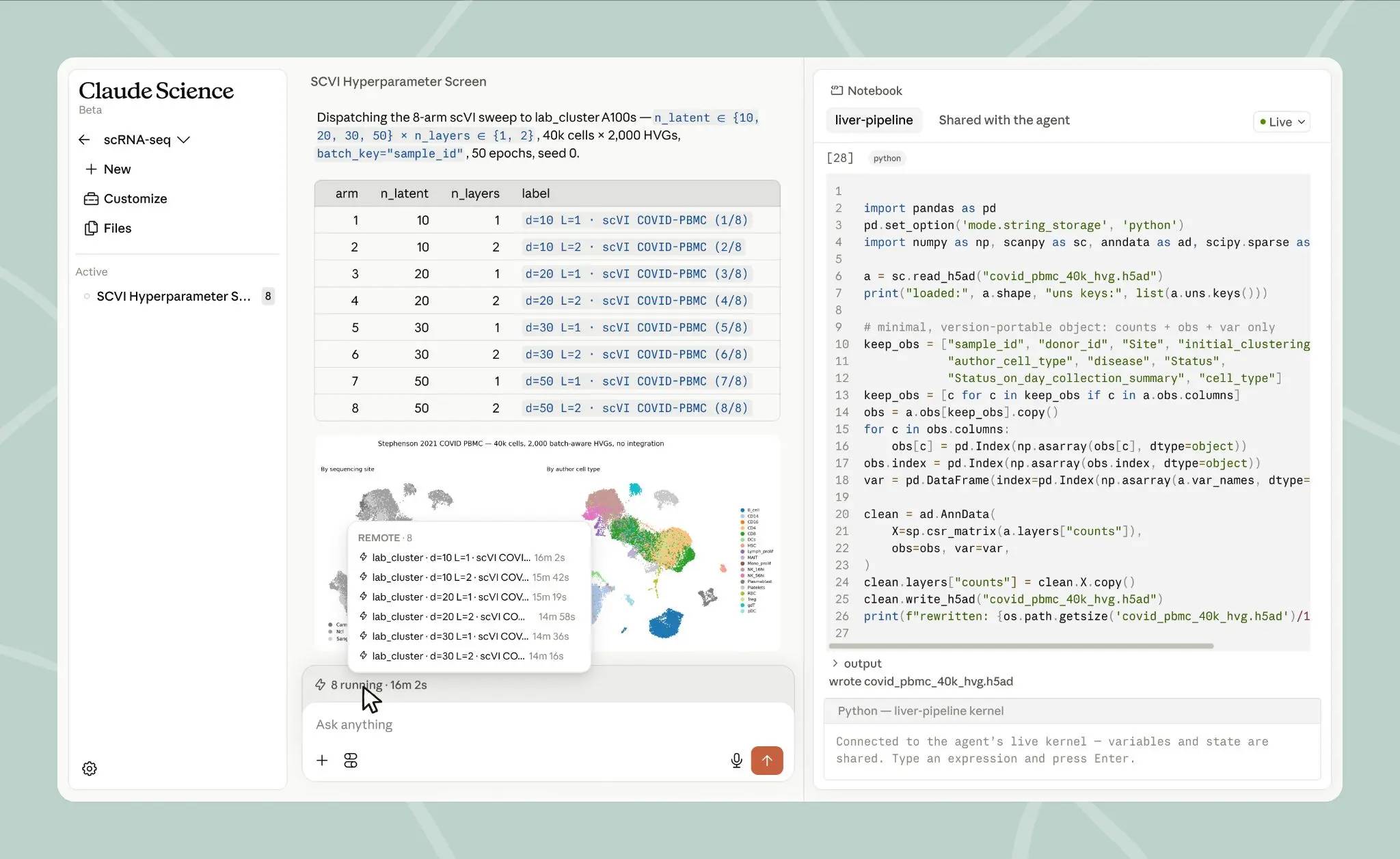
It handles resource management and scales automatically when demand spikes. Large-scale analysis tasks — protein folding simulations, genomic data processing on massive datasets — normally force researchers to waste time on infrastructure work: setting up compute jobs, waiting for cluster handoffs, checking if things succeeded, collecting output. Claude Science handles all of that for you. The system auto-plans workloads, asks for approval before requesting extra resources, and lets you review or cancel decisions before launching anything on your lab's existing infrastructure (your internal HPC cluster via SSH or a Modal account for on-demand compute). You can scale from a single GPU to hundreds depending on what the analysis actually needs.
Because agents within a single session maintain context in memory, even massive datasets load once and stay there. The system runs directly on your lab's infrastructure — laptop, Linux server, or HPC login node — so large or sensitive datasets never leave your storage. Only the context necessary for each analysis step gets sent to Claude. During execution, a validation agent monitors outputs, catches errors like bad citations, unsourced numbers, or images that don't match their code, and fixes them automatically on the fly. You can fork a session anytime to compare two different approaches without losing your original workflow.
What makes Claude Science different?
Here's another big time-saver: Claude Science runs on your lab's infrastructure instead of shipping data to Anthropic's servers.
Early adopters are already putting this to work. Neuroscientist Jérôme Lecoq at the Allen Institute used it to build a multi-agent computational evaluation workflow. Stephen Francis's team at UCSF's brain center accelerated their comprehensive glioblastoma analysis dramatically — getting results validated independently in a fraction of the time it used to take.
Claude Science's launch comes months after OpenAI tackled the same problem from a different angle. In April, OpenAI released GPT-Rosalind, a specialized model fine-tuned for biological reasoning.
The gap between these approaches isn't just about whether a specialized model is necessary — it's about who gets access and how fast. Rosalind shipped as a research preview, locked to qualified U.S. enterprise customers after safety and quality review. Early partners like Amgen, the Allen Institute, Moderna, Thermo Fisher, and Novo Nordisk got in first.
Then there's Google DeepMind playing a completely different game. DeepMind actually owns foundational science models like AlphaFold and AlphaGenome — the other two companies can only use these as tools. Their Gemini for Science platform integrates those models with 30+ life-science databases into a single skill set.
So three wildly different distribution strategies are competing for the same research market: Anthropic expanding reach through broad subscription access, OpenAI narrowing scope to enterprise-only, and Google leveraging proprietary models nobody else owns. The real concern is that this distribution split might signal how AI vendors will compete in other specialized fields — law, finance, engineering — down the line.
Claude Science is in beta now for anyone on a Pro, Max, Team, or Enterprise subscription. Anthropic named Novo Nordisk and the Allen Institute as customer case studies, showing pharma organizations are already working with multiple AI vendors.
Anthropic is also backing up to 50 Claude Science projects with up to $30,000 in credits each. "We're looking for postdoc and postgrad projects across many fields that push the boundaries of science, with initial focus on biomedical research," the company states. Application deadline is July 15, 2026, with winners announced by July 31. Projects run from September 1 through December 1, 2026.
Description: Anthropic launches Claude Science, an AI workspace that helps scientists manage complex research workflows without switching between tools.
Related Articles
- Microsoft Copilot vs ChatGPT: Which AI Assistant Should You Actually Use?
- Teaching AI to Remember Your Writing Style: A Self-Learning System
- What is Google Sheets Canvas? Turn Your Spreadsheet into an Interactive Dashboard
- 5 Safety Guardrails Built Into Claude Code to Stop Costly Terminal Mistakes
- How to Use Copilot to Schedule Reminders and Calendar Events

No Comment to " Claude Science: Anthropic's AI Platform Built for Research Labs "