GLM-5.3 Flash: Z.ai's Multimodal Model That Costs 90% Less Than the Competition
Table of Contents
- What is GLM-5.3 Flash?
- Hybrid Architecture: Cost-Efficient Attention at 1 Million Tokens
- Benchmark Performance Results for GLM-5.3 Flash
- Built-In Multimodal: Image Processing in Your Workflows
- Pricing: What Does GLM-5.3 Flash Actually Cost?
- GLM-5.3 Flash vs. GLM-5.3: Side-by-Side
- Why GLM-5.3 Flash Matters for AI Agent Development
- Deploying GLM-5.3 Flash on Your Own Infrastructure
Z.ai released GLM-5.3 Flash on August 26, 2026—and it's the first truly native multimodal model in the GLM-5 lineup. The company dropped it under the MIT license with a 1-million-token context window (according to Z.ai's X post). Here's what makes this interesting: it's a 320 billion parameter model with 18 billion active parameters per token, and Z.ai claims it outperforms GLM-5.2 on coding and agent tasks while costing roughly one-tenth as much. Below, we break down what's actually new, the benchmark scores that matter for agents, the pricing, and how it stacks up against GLM-5.3.
What is GLM-5.3 Flash?
GLM-5.3 Flash is a Mixture-of-Experts (MoE) model with 320 billion total parameters and 18 billion active parameters per token (per TestingCatalog). Z.ai positions it as the cost-efficient, high-throughput variant of their GLM-5 family: strong performance on coding and agent tasks, but engineered to run cheap and fast.
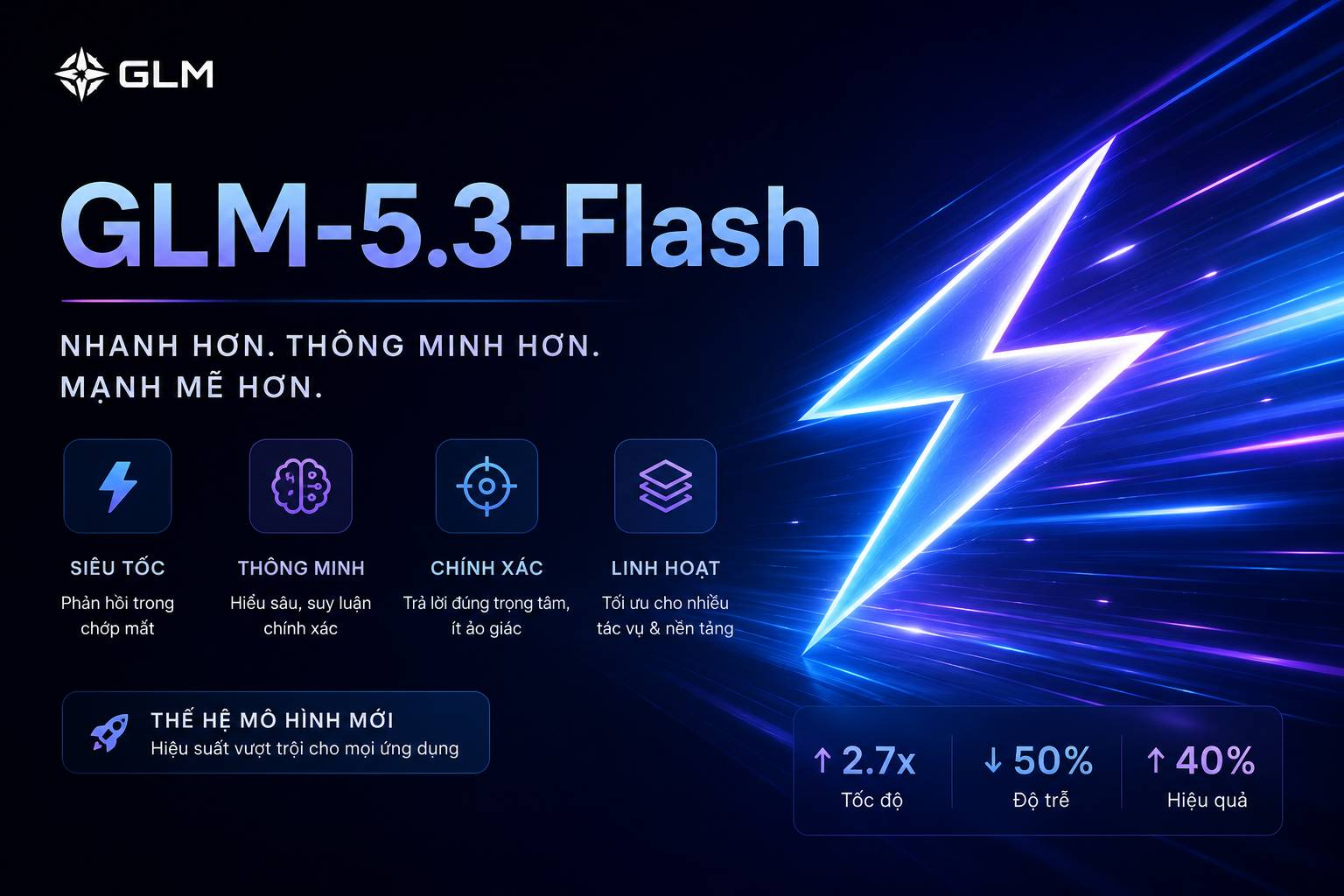
Two things set it apart from earlier GLM releases. First, it's the first natively multimodal model in the GLM-5 product line—image handling was baked into training from day one, not bolted on afterward. Second, it ships under the MIT license with open weights on Hugging Face. If the name "Ox Alpha" rings a bell, that's because this is the same model. It was running anonymously as ox-alpha on OpenCode and OpenRouter for about a week before the official announcement.
Hybrid Architecture: Cost-Efficient Attention at 1 Million Tokens
The performance story starts with attention mechanism design. According to Z.ai, GLM-5.3 Flash is the first open-source model to combine sparse attention and linear attention in a hybrid architecture—linear attention for local dependencies, sparse attention for globally relevant context (per Z.ai's technical docs).
The results are striking. Compared to GLM-5.3, Z.ai reports that attention computation overhead drops by roughly 3x and KV cache shrinks by 4.4x (per TestingCatalog). At context lengths stretching to 1 million tokens, a component Z.ai calls IndexPool compresses key-value index groups to reduce latency and memory footprint. This is why the 1-million-token window actually works in practice—it's not just a spec sheet number. Long-running agents can maintain richer context without costs spiraling out of control.
The model was trained on a massive multimodal dataset containing 30 trillion tokens. Z.ai built this from a completely fresh foundation rather than reusing their GLM-5.2 base—a shift from how they approached GLM-5.3, which started from GLM-5.2 and only scaled up during post-training.
Benchmark Performance Results for GLM-5.3 Flash
All numbers below come from vendor reports or independent tracking services. Because testing tools and experimental setups vary, treat these as directional indicators rather than head-to-head comparisons.
On coding and agent-capability benchmarks against GLM-5.2, the jumps are substantial—not incremental (per OfficeChai):
- DeepSWE v1.1: 46.2 → 63.4
- AutomationBench: 26.2 → 48.8 (nearly doubled)
- Terminal-Bench 2.1: 84.3—beating DeepSeek-V4-Vision-Exp and trailing Claude Opus 4.8's 85.0 by a slim margin.
On the same Terminal-Bench test, GPT-5.6 Terra (87.4) and Gemini 3.7 Flash (85.8) still lead slightly, but the gap has narrowed considerably from GLM-5.2's previous position. On Z.ai's internal Code Bench v1.0—running on Claude Code—GLM-5.3 Flash hits 29.0 points versus 29.5 for Opus 4.8. The company argues this proves their "flash" tier (fast, cheap) models can now compete with frontier coding systems.
On the independent Artificial Analysis Intelligence Index, GLM-5.3 Flash scores 57 points—well above the median for models in its price bracket. A fair caveat: internal benchmarks like Code Bench can't be replicated by third parties, and this model doesn't claim to beat GPT-5.6 Sol or Fable 5 on the hardest public benchmarks. That's by design—it delivers practical value rather than chasing benchmark leaderboard spots.
Built-In Multimodal: Image Processing in Your Workflows
Multimodal isn't a separate feature—it's woven into the model's core logic. Z.ai trained GLM-5.3 Flash to observe rendered interfaces, game state, and 3D outputs, then self-evaluate and iterate on its own work based on those visual signals (per TestingCatalog).
This "look-and-fix" loop matters especially for UI-building agents or dashboard work: the model sees a rendered webpage, spots errors, and applies iterative corrections. The approach extends beyond code to documents, spreadsheets, presentations, and meeting notes—enabling reasoning that mixes text, images, and data structure, outputting finished files in PPTX, PDF, DOCX, and XLSX formats (per Z.ai docs).
Pricing: What Does GLM-5.3 Flash Actually Cost?
Price is the headline. Z.ai's standard API pricing runs $0.15 USD per million input tokens and $0.50 USD per million output tokens, with cached input at $0.03 USD per million tokens (per Z.ai's X announcement). Third-party providers go even lower—OpenRouter lists $0.075 USD for input and $0.25 USD for output (per OpenRouter).
For GLM Coding subscribers, the model ships with a 3x higher usage allowance compared to GLM-5.3 (TestingCatalog). This is the real-world difference versus pricier plans: you can run long-running agent loops without worrying about token budget burn.
GLM-5.3 Flash vs. GLM-5.3: Side-by-Side
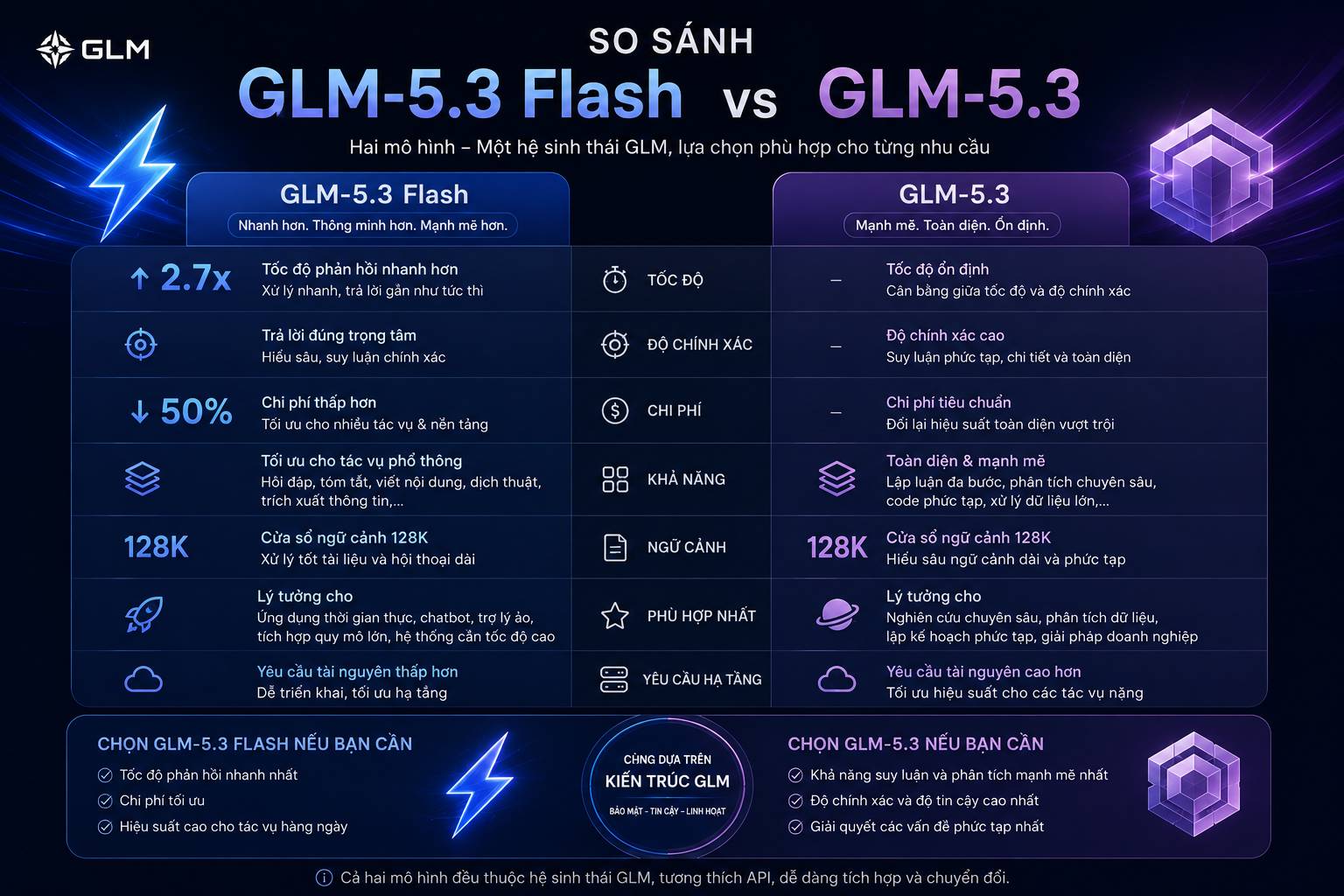
They're built for different purposes. GLM-5.3 is a reasoning-focused coding model—it unexpectedly developed cybersecurity skills and carries pre-trained safety evaluation weights. GLM-5.3 Flash, by contrast, is the efficiency play: multimodal native, MIT-licensed, and designed to run cheap at scale.
Quick comparison:
- Modality: GLM-5.3 focuses on text; GLM-5.3 Flash is multimodal at its foundation.
- Architecture: GLM-5.3 reuses GLM-5.2's base; GLM-5.3 Flash uses a fresh foundation with a hybrid sparse-linear attention mechanism.
- Efficiency: GLM-5.3 Flash consumes roughly 3x less compute in attention and has a 4.4x smaller KV cache than GLM-5.3.
- License and Weights: GLM-5.3 Flash releases under MIT with open weights from day one; GLM-5.3's weights rolled out in phases.
- Cost: GLM-5.3 Flash is priced for scale—around one-tenth of GLM-5.2's cost (per Z.ai).
Need deep reasoning for complex problems? GLM-5.3 is your move. Running multimodal agents or long-horizon tasks where per-task cost determines feasibility? GLM-5.3 Flash is worth testing.
Why GLM-5.3 Flash Matters for AI Agent Development
A few practical takeaways:
- It's the cost play for continuous-running agents. At $0.075–0.15 USD per million input tokens with a practical 1-million-token window, GLM-5.3 Flash makes long-running agent loops economically viable—something current frontier models haven't achieved.
- Multimodal changes what agents can verify. A model that can "see" rendered interfaces and edit them closes feedback loops that text-only agents can't—crucial for UI work, dashboards, and documents.
- MIT licensing removes friction. Open weights under a permissive license mean teams with data-residency or vendor-evaluation constraints can self-host from day one. Deployment supports tools like SGLang, vLLM, and TokenSpeed.
- Treat internal benchmark results as a starting point. Code Bench data is fresh and hadn't been published widely before. Independent testing really kicks off now that weights are public.
Deploying GLM-5.3 Flash on Your Own Infrastructure
GLM-5.3 Flash is purpose-built for multimodal, cost-efficient, long-horizon agent loops—workflows that run end-to-end rather than responding to single commands. It's the first natively multimodal GLM-5 model (320B-A18B), MIT-licensed, supports 1 million token context, and priced to keep day-long agents running affordably.
Description: Z.ai's new GLM-5.3 Flash combines multimodal capabilities with a hybrid attention architecture and costs just 1/10 of comparable models. Here's what y
Related Articles
- How to Disable RGB Lighting on Your Mouse and Keyboard During Shutdown
- Comparing 120+ Open-Source LLMs: The Best Models in 2026
- Specification Engineering: The Next Critical Skill Beyond Prompt Engineering
- How to Boot Windows 10 into Safe Mode: 5 Different Methods
- Integrating Google Calendar into n8n Using OAuth2: A Complete Setup Guide

No Comment to " GLM-5.3 Flash: Z.ai's Multimodal Model That Costs 90% Less Than the Competition "