8 Essential Safety Tips for Using ChatGPT, Gemini, and Other AI Tools Securely

AI chatbots have quietly become the go-to tool for nearly everything—finding recipes, planning trips, tackling work projects, even venting about personal struggles. But here's the catch: that convenience comes with a hidden cost. Most people unknowingly hand over sensitive information without realizing what happens to it next.
Unlike doctors, lawyers, or therapists who operate under strict confidentiality rules, AI chatbots only answer to their provider's terms of service—something most users have never actually read. The real concern is that your data might not be protected the way you assume it is.
Beyond privacy issues, research is increasingly showing that heavy reliance on AI can impact memory, creativity, and writing skills. So before your next conversation with ChatGPT, Gemini, Claude, or any other chatbot, keep these eight principles in mind.
1. Treat AI Chatbots Like Public Spaces, Not Private Conversations
Matthew Stern, a cybersecurity investigation expert and CEO of CNC Intelligence, recommends thinking of AI chatbots as public environments rather than private chats. Once you adopt that mindset, you naturally become more cautious about sharing sensitive data that could be stored or surfaced elsewhere later.
Conversation histories with chatbots can already be indexed on the internet in some cases. Never enter personally identifiable information like full names, addresses, phone numbers, financial details, business data, or medical records.
Sure, feeding AI more data helps it personalize responses better. But that also means you're handing valuable information directly to tech companies. Even if the data stays private, you can't predict how it'll be used or combined with other sources down the road.
2. Don't Overshare Your Mental Health and Emotional State

According to Elie Berreby, SEO and AI Search Director at Adorama, AI chatbots can be helpful tools—but they're not your friends.
He advises against confiding in AI about mental health, fears, stress, or health concerns. This data can be weaponized to build behavioral profiles, detect psychological patterns, and infer things about you that you haven't even realized yourself.
Berreby emphasizes: "Don't share too much. They know more about you than you think." He also points out that most AI platforms ultimately exist to generate revenue. Down the line, your personal data could easily be repurposed for hyper-targeted advertising.
3. Don't Upload Your Entire Life to a Chatbot
Annalisa Nash Fernandez, an expert in cross-cultural strategy, notes that AI chatbots operate within an attention economy where user engagement is the most valuable currency.
Features like Memory—which remember your preferences and details—are marketed as personalization tools. What isn't highlighted is that they simultaneously help platforms accumulate more data about you.
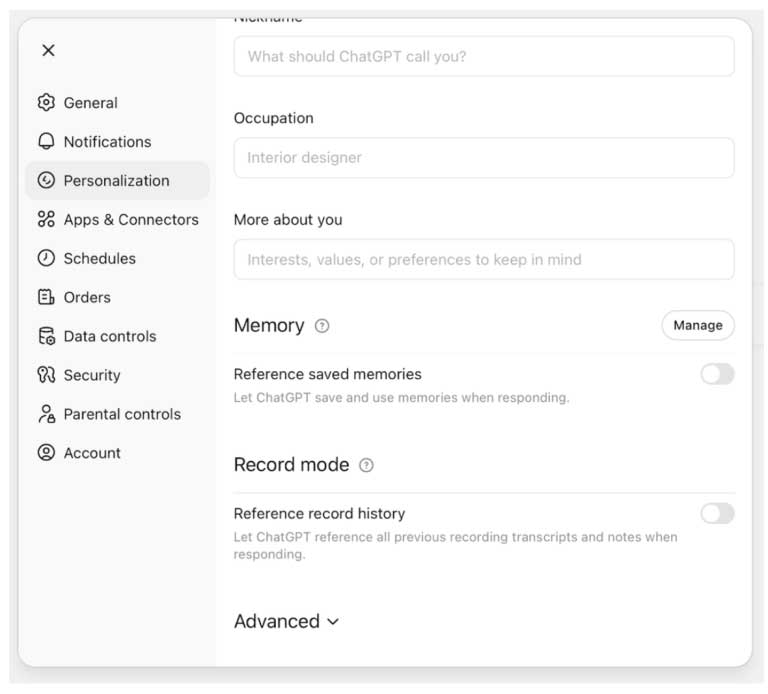
Unless absolutely necessary, disable memory features. In ChatGPT, navigate to Settings > Personalization, then turn off Memory and Record Mode.
Fernandez also suggests using a secondary email address instead of your primary one when signing up for AI accounts. Your main email is like a master key that links together all your other personal data.
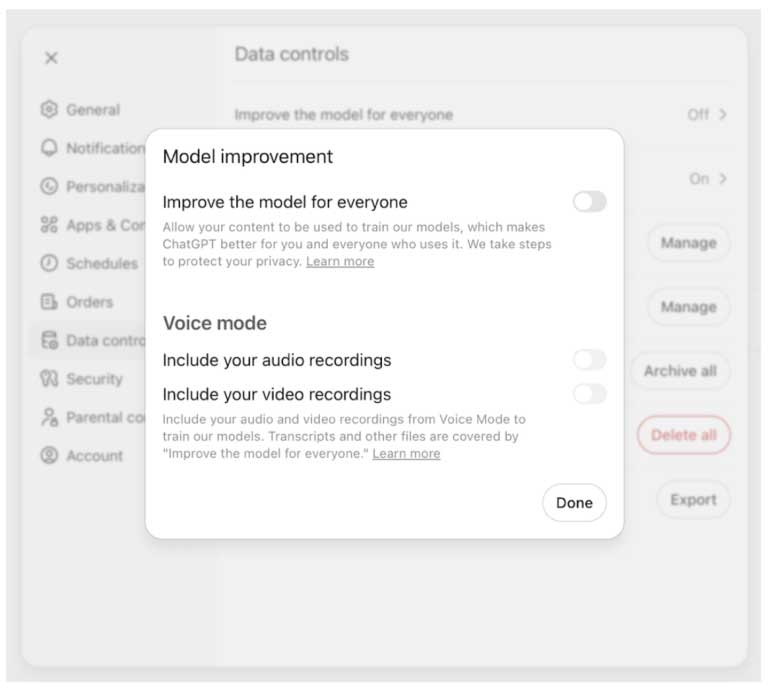
Additionally, disable the option that allows platforms to use your data for model training. In ChatGPT, go to Settings > Improve the model for everyone and turn it off.
Here's another tip from Berreby: don't rely on just one chatbot. Rotating between different AI platforms prevents any single company from building a complete picture of your life.
4. Regularly Export Your Own Data
Most AI chatbots today let users download all their stored information. You should do this periodically to see exactly what the platform is keeping about you.
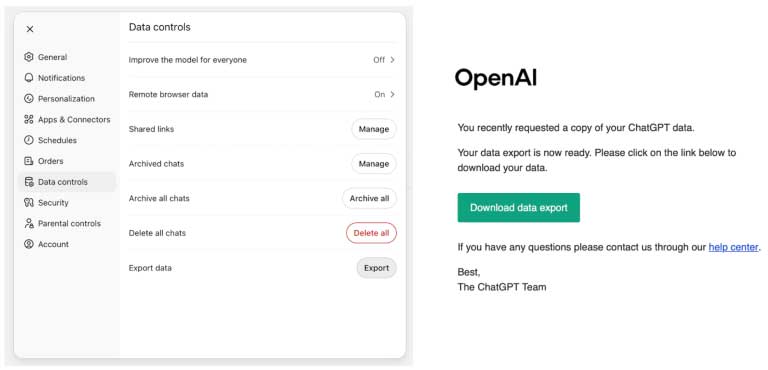
With ChatGPT, simply go to Settings > Data Controls > Export Data. The system sends a download link via email containing a ZIP file with your entire conversation history and related content.
5. Verify Everything AI Tells You
AI is designed to be helpful and always tries to answer your questions. But that doesn't mean the answers are correct.
Chatbots can make mistakes, reason incorrectly, or even fabricate information that doesn't exist (a problem called AI Hallucination). What's interesting here is that if you use AI as a "devil's advocate," it tends to reflect your own viewpoints back at you—trapping you in an echo chamber that reinforces what you already believe.
Always verify sources. Ask the AI where it got its information and cross-reference with reliable sources before using any output.
6. Watch Out for Fake Chatbots
Ron Kerbs, CEO of Kidas, points out that scammers are exploiting AI's multi-turn conversation abilities. Fake websites now use chatbots impersonating customer support to steal login credentials or trick users into visiting phishing sites.
Even though ChatGPT and Gemini are secure platforms, your account can still be compromised if you log in through fake emails, phishing texts, or counterfeit websites.
To reduce risk:
- Enable two-factor authentication (2FA).
- Review your account login history regularly.
- Never log in through links from unknown emails or websites.
Fraud detection tools and deepfake recognition technology are becoming increasingly essential for spotting AI-generated calls, videos, and messages.
7. Talk to Real People, Not AI
This isn't a security tip, but it's important. If you're struggling, reach out to friends, family, or people who genuinely care about you—not to ChatGPT, Gemini, or Claude as if they were a diary or therapist.
AI can simulate empathy, but it's really just a language prediction model trained on data from millions of other people. It can't replace genuine human connection.
8. Don't Let AI Do Your Thinking
Early research from MIT suggests that over-relying on large language models can reduce neural activity associated with critical thinking.
While these findings still need validation, the message is clear: don't outsource your entire thought process to AI.
Use AI for repetitive tasks like summarizing documents, editing text, or automating simple workflows. But creativity, analysis, planning, and final decisions should stay with you.
Conclusion
AI chatbots like ChatGPT, Gemini, and Claude offer tremendous benefits for learning and work, but they come with real risks around privacy, data security, and even cognitive independence.
Using AI safely isn't just about avoiding sensitive information—it's about maintaining healthy distance from the technology. Think of AI as a tool that assists you, not as a confidant or a replacement for your own judgment.
Description: Learn how to protect your privacy and data when using AI chatbots. Essential safety guidelines for ChatGPT, Gemini, Claude, and similar platforms.
Related Articles
- Running Qwen 3.5 Locally on a Single GPU: Complete Setup Guide
- Teaching AI to Remember Your Writing Style: A Self-Learning System
- Best AI Tools for Microsoft Excel in 2026: Data Analysis, Formulas & Charts
- Why You Should Downgrade from Copilot and Switch to Claude for Office Work
- Meet Muse Glimmer: Meta's Open-Source Agent AI That Runs Entirely on Your Device

No Comment to " 8 Essential Safety Tips for Using ChatGPT, Gemini, and Other AI Tools Securely "