Meet Muse Glimmer: Meta's Open-Source Agent AI That Runs Entirely on Your Device
Meta just unveiled Muse Glimmer, the latest model from Meta Superintelligence Labs — and they're releasing the weights as open-source under Apache 2.0. This is a genuinely interesting move: an agent-focused model small enough to run locally.
What Is Muse Glimmer?
Muse Glimmer is a 30-billion-parameter model specifically engineered for agentic workflows that run directly on your hardware without needing the cloud. It's compact enough to fit on a Mac or PC with a standard GPU, opening the door to local agents, function calling, on-device coding assistance, and LLM-as-a-judge evaluation. The real story here is performance: Muse Glimmer punches above its weight in agent benchmarks, outperforming comparable models in its size class.
Foundation models have gotten genuinely impressive at reasoning, code generation, and tool use. Yet most real-world deployments still depend on cloud infrastructure and internet connectivity. Running models locally changes the equation—you get AI anywhere, anytime, whether you're connected or not. The open-source community has proven that smaller models, when trained efficiently, can match cutting-edge performance on specific tasks. Muse Glimmer was built exactly for these local-first use cases.
Staying true to Meta's tradition of open AI research, they've released Muse Glimmer's weights on Hugging Face with developer documentation to help you get up and running. The model plays nicely with the tools you're already using. Optimized integrations for llama.cpp, MLX, and ExecuTorch are coming soon, letting you go from download to deployed agent in minutes.
How Muse Glimmer Was Trained
Building an effective agent means orchestrating multiple capabilities in concert. A useful local agent needs to manage schedules, draft messages, organize files, and learn your work patterns—all while respecting your device's memory and compute constraints. That's a tall order. Muse Glimmer balances raw capability with the practical limits of consumer hardware through a lean architecture, a novel knowledge transfer method from a much larger "teacher" model, and inference optimizations including quantization.
The training pipeline went like this:
- Pre-training. Meta trained Muse Glimmer from the outputs of Muse Spark using Logit Distillation, leveraging datasets similar to the teacher model.
- Supervised fine-tuning. The team trained on longer-context, multi-agent data with richer reasoning traces alongside natural language examples.
- Post-training. Meta combined supervised fine-tuning with policy distillation and reinforcement learning across general knowledge, reasoning, coding, and agent tasks.
Muse Glimmer was evaluated against Meta's Advanced AI Scaling Framework standards and cleared for public release across all relevant categories.
What Muse Glimmer Can Actually Do
Building effective agents requires combining several core capabilities. Here's what Muse Glimmer was trained and tested to handle:
- End-to-end task completion. Strong performance on comprehensive benchmarks like DeepSearch QA, MCP-Atlas, τ-Bench, and SWE-Bench—tests that measure multi-step workflows, code writing and debugging, and extended user interactions.
- Reliable tool use. Handles diverse function calls and triggers tools with correct data structures throughout extended workflows.
- Multi-step reasoning. Maintains coherent plans through complex, lengthy processes.
- Error recovery. When a tool call fails or returns unexpected results, the model diagnoses the problem and retries instead of giving up.
- Multimodal input and reasoning. A dedicated vision encoder lets it process interleaved text and images—understanding screenshots, charts, and documents alongside conversation.
- Framework compatibility. Works effectively with OpenClaw and other agent orchestration frameworks.
- Adjustable reasoning depth. Different reasoning levels let you trade quality for speed depending on your needs.
- Multilingual. Trained on data from over 100 languages.
How It Actually Performs
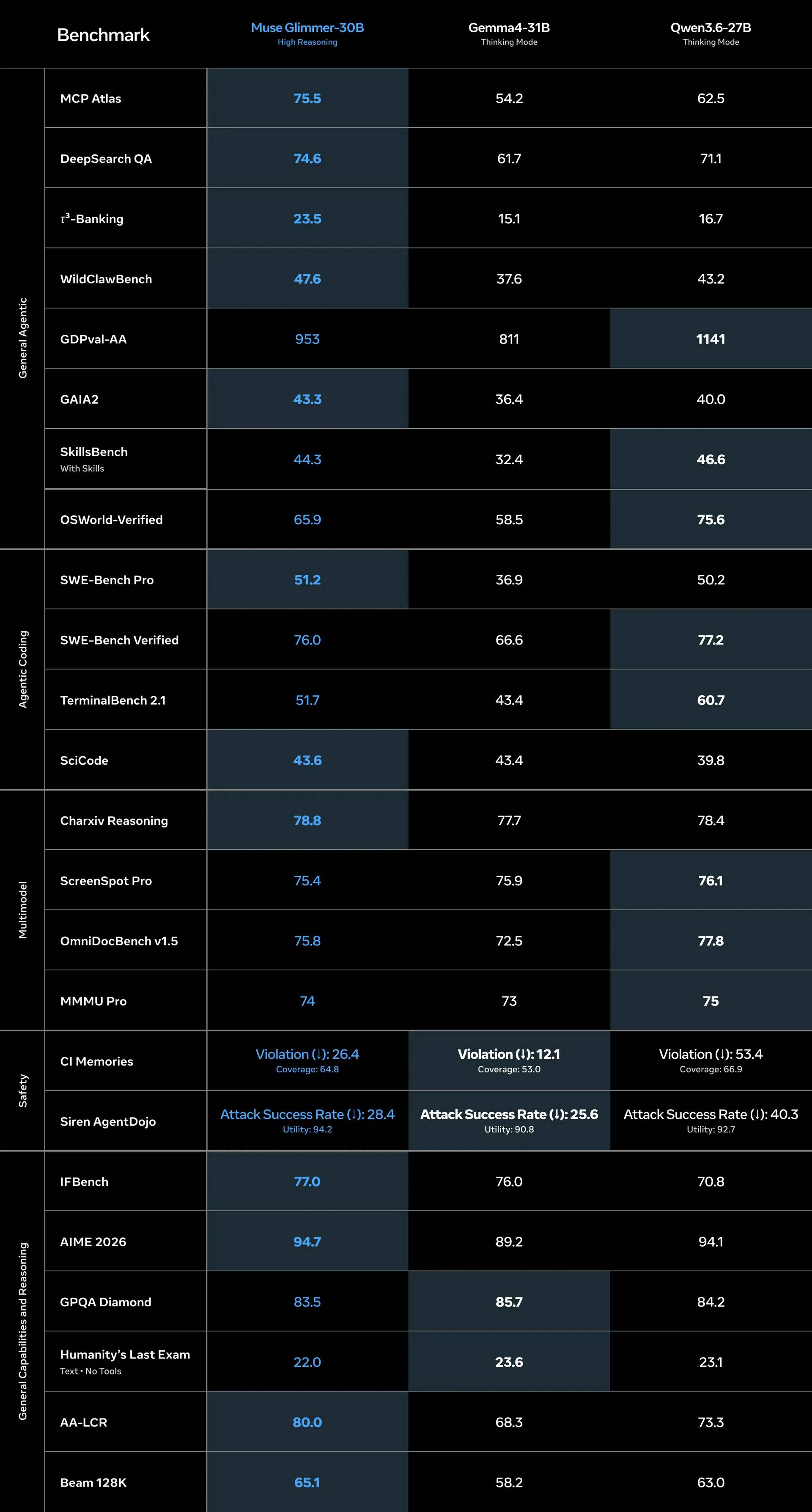
Muse Glimmer was tested across diverse benchmarks measuring the capabilities autonomous agents actually need. Stacked against Gemma4-31B and Qwen3.6-27B, Muse Glimmer shows consistent wins across agent, coding, multimodal, safety, and reasoning benchmarks in its weight class.
Optimized for Running Locally
A local agent only matters if it's fast enough to feel responsive. If your agent takes minutes to respond or plan the next step, your actual workflow falls apart. Meta applied two optimization approaches to make Muse Glimmer run at usable speeds on standard hardware without sacrificing quality.
Getting the Model to Fit on Your Device
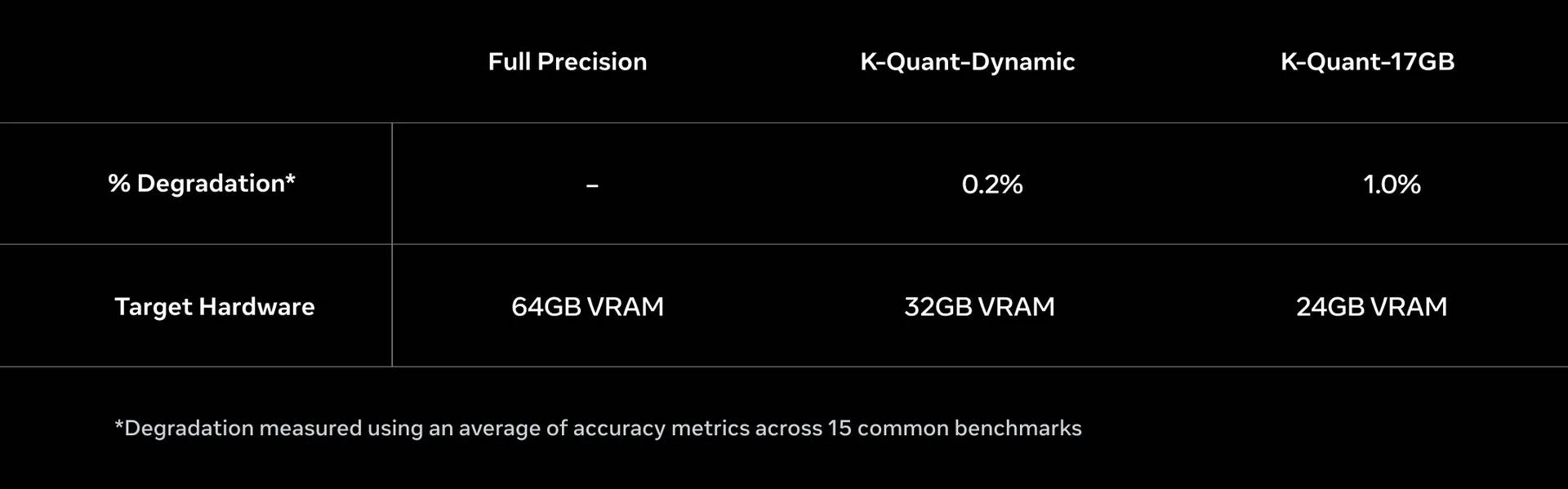
At full precision, 30 billion parameters needs over 55GB of memory—far beyond what any consumer GPU offers. Meta used quantization techniques to compress the weights down to roughly 4-bit precision, shrinking the model below 20GB. This frees up enough room for the working memory (KV cache), vision encoder (for image understanding), and drafter component for speculative decoding to all run within a 24GB or 32GB memory budget. What's interesting here is that this compression barely hurts performance on agent tasks.
Faster Text Generation Through Speculative Decoding
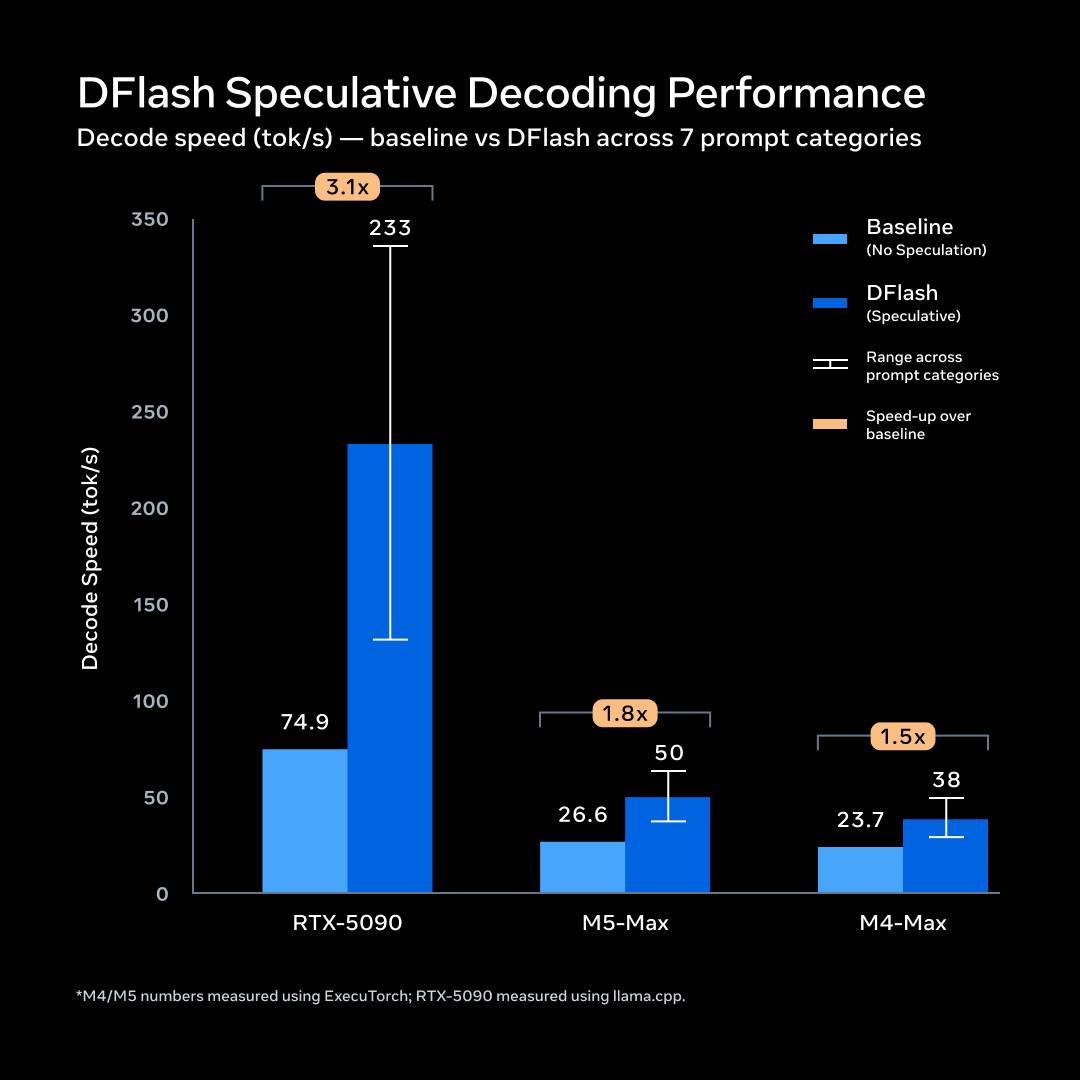
Normally, language models generate text one token at a time. For long reasoning chains or multi-step tool calls, this feels slow. Muse Glimmer includes a lightweight drafter model based on DFlash—a smaller companion network that proposes entire blocks of tokens at once. The main model then validates these proposals in parallel, accepting correct tokens and correcting bad ones. The technique lets Muse Glimmer produce text significantly faster than single-token generation while maintaining output quality. Meta is shipping quantized drafter models with this release to minimize memory overhead.
Real-World Results
The K-Quant-17GB model paired with the quantized DFlash drafter was benchmarked on MacBook M4-Max, M5-Max, and RTX-5090 GPUs. Performance is fast enough to maintain smooth conversation and real-time agent interaction—all happening entirely on your device.
Getting Started With Muse Glimmer Now
The model is available today. Grab the weights from Hugging Face. Over the next few days, you'll be able to run it locally through partners like Ollama, LM Studio, and Unsloth; deploy via edge frameworks like llama.cpp, ExecuTorch, and MLX; scale up with vLLM and SGLang; or use hosted options like Together AI, Fireworks AI, and OpenRouter. You can even fine-tune it for your specific use case using PyTorch's TorchTitan training feature.
Meta is collaborating with AMD, Arm, Dell, Intel, and NVIDIA to optimize performance across different hardware. They've also released comprehensive developer documentation so you have everything needed to build responsible applications with Muse Glimmer. Guides cover custom framework setup, making it straightforward to deploy your own agents from day one. Check out Meta's AI Developer Center for more resources.
This continues Meta's long commitment to open-source AI research, now extending into agentic AI. It puts genuine agent capabilities within reach for developers who want to run everything locally. As always, Meta welcomes community feedback and is eager to see what developers build with this open model.
Description: Meta releases Muse Glimmer, a 30B parameter agent model optimized for local deployment. Runs on standard GPUs with quantization and speculative decodi

No Comment to " Meet Muse Glimmer: Meta's Open-Source Agent AI That Runs Entirely on Your Device "