Essential Agentic AI Fundamentals Every Machine Learning Engineer Should Know

Ask a chatbot to find hotels in London, and you'll get a list to browse yourself. Ask an AI agent the same question, and it autonomously checks availability, compares prices across platforms, books your room, and sends a confirmation email. That gap between "providing information" and "taking action on behalf of humans" defines Agentic AI—and it's become one of the most discussed topics in enterprise AI strategies heading into 2026.
Here's the catch: Agentic AI isn't a single technology. It's a collection of different technical components working together. Misunderstand any one of them, and you'll build agents that lose conversation history, can't use external tools, or work flawlessly in demos but crash the moment they hit production.
The numbers tell a sobering story. Roughly 88% of AI agent projects never make it to production, and the culprit isn't weak language models—it's development teams lacking solid foundational knowledge. What's interesting here is that most failures stem from overlooked technical fundamentals rather than raw model capability.
1. Tool Use and Model Context Protocol (MCP)
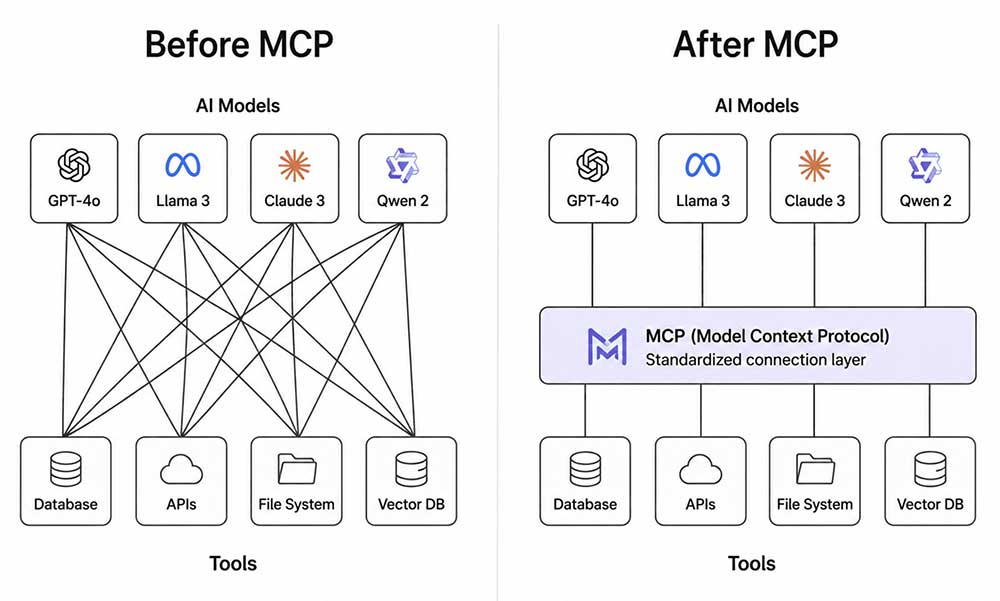
An LLM on its own can only generate text. To query databases, call APIs, read files, or send emails, it needs a bridge to the outside world—and that's where Tool Use comes in. Traditionally, each service required engineers to write a custom integration layer. Scale that across dozens of AI applications and hundreds of tools, and you're drowning in boilerplate code that becomes a maintenance nightmare.
Anthropic tackled this problem by introducing Model Context Protocol (MCP) in late 2024. Within a year, OpenAI, Google, Microsoft, and other major tech companies adopted it. By end of 2025, it transferred to the Linux Foundation to become an open industry standard. But here's what really matters: MCP standardizes how AI agents communicate with external tools.
Instead of writing a custom SDK for each service, an agent reads an MCP server's capability list and sends requests using a unified JSON-RPC format. Suddenly, your agent can work with GitHub, Slack, Notion, databases, or thousands of other services through a single protocol. Yes, MCP adds token overhead and latency compared to direct API calls—a real tradeoff to consider.
But if you're managing OAuth, handling multi-tenant permissions, or want non-technical users to connect AI to external tools, MCP is close to the optimal choice.
2. Memory and Context Engineering
By default, each LLM call is completely isolated. Once it answers, the model forgets the entire conversation unless you feed back the chat history. That's fine for simple chatbots, but it's a major blocker for agents that need to work across multiple days, handle ongoing customer support across sessions, or manage projects spanning weeks.
This is why Memory has become an independent architectural component rather than just an extension of context windows. In modern systems, a dedicated Memory layer automatically extracts important information during conversations, stores it in a Vector Database organized by user, session, or agent, and retrieves relevant memories using semantic search, keyword matching, or entity matching when starting a new session. The agent then incorporates these memories into the LLM's context before generating a response.
The user experience feels like the AI remembers them, even though it's really performing an intelligent retrieval step before each response. Platforms like Mem0, Zep, and Letta have become popular alternatives to building custom memory systems in-house. Running parallel to Memory is Context Engineering.
The AI community has shifted focus from Prompt Engineering to strategically selecting, compressing, and organizing information fed to the model. A large context window doesn't guarantee smarter AI if that information lacks curation. What determines output quality isn't the volume of context—it's the quality.
3. Planning and Reasoning Loop
Unlike chatbots that answer once and exit, AI agents must constantly plan, act, observe results, adjust strategy, and repeat. This cycle is the critical difference between conversational AI and autonomous working AI.
The concept originates from ReAct (Reasoning + Acting) research published by Google and Princeton University in late 2022. Rather than pure reasoning or pure action, the model alternates between them in a Thought → Action → Observation → Thought cycle.
Modern Agentic AI frameworks have expanded this pattern with automatic retry logic when tools fail, self-correction, task decomposition into subtasks, and result verification at each step. Instead of accepting "analyze the market" as a single request, the AI breaks it into data collection, competitor classification, information synthesis, and report generation.
The real concern is that this is where production errors flourish most. Without proper controls, agents can burn through tokens rapidly, enter infinite loops, or gradually drift from their original objective. Planning Loops aren't just reasoning techniques—they're infrastructure components that need monitoring and optimization like any other software system.
4. Multi-Agent Orchestration
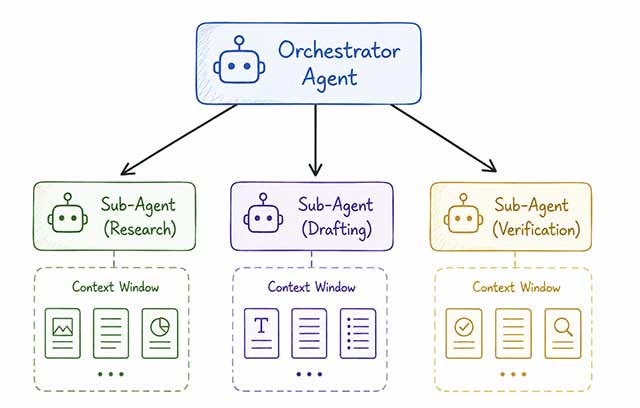
A single AI agent always hits limits on how much information it can process simultaneously. Feed it an entire codebase, lengthy research papers, and complex business rules all at once, and it quickly loses focus on what matters. That's why Multi-Agent architectures became a major trend in 2026.
Instead of one agent handling everything, the system distributes work across specialized AI agents coordinated by an Orchestrator Agent. Each Sub-Agent focuses narrowly on one task with its own context, making both processing faster and outputs more accurate. Recruiting platform Fountain demonstrated this by applying Multi-Agent architecture to candidate screening, accelerating evaluation by ~50%, cutting onboarding time by ~40%, and compressing the entire hiring process from weeks to under 72 hours.
Today, LangGraph earns top marks for production systems thanks to checkpoint management and state handling. CrewAI suits projects needing rapid role-based deployment. AutoGen remains popular in research environments. Beyond MCP, Google introduced Agent2Agent (A2A) protocol to standardize how multiple AI agents communicate. Where MCP connects AI to tools, A2A lets agents from different frameworks discover each other's capabilities and collaborate on shared tasks.
5. Evaluation, Observability, and Guardrails
This section rarely gets the attention it deserves, yet it determines whether an agent survives in the real world. Statistics show 88% of Agentic AI projects never reach production, while successful ones deliver average ROI of 171%. The difference isn't which model you chose—it's how thoroughly you engineered the technical process.
First comes Observability: the ability to track everything your agent does—which tools it calls, what steps it takes, what it observes, where errors occur. Platforms like LangSmith are becoming the standard for logging this entire lifecycle, making debugging far easier when things break.
Then comes Evaluation, which measures output quality. If Observability answers "what happened," Evaluation answers "did the AI actually do it right?" More platforms now auto-generate evaluation criteria and score agents across multiple dimensions instead of just flagging pass/fail.
Finally, Guardrails are safety controls layered throughout the AI's lifecycle—input validation, reasoning monitoring, internal state tracking, tool call authorization, and output assessment. These don't replace humans but help organizations understand precisely what to check and when. Gartner predicts over 40% of Agentic AI projects could be abandoned before end of 2027 due to rising costs, unclear business value, and missing risk controls. Most of these failures could be caught early with proper investment in Evaluation, Observability, and Guardrails from the design phase onward.
None of these five concepts works well in isolation. If you're starting fresh, you don't need to master all five before writing any code. Pick a well-defined task, connect a single agent to MCP for tool access and a basic memory layer, watch how it reasons through a few real runs, and only introduce multi-agent coordination when a single agent genuinely can't handle the scope. Start evaluating from day one—don't wait for failures to force it.
Description: Master 5 core concepts of Agentic AI: Tool Use, Memory, Planning Loops, Multi-Agent systems, and production safeguards.
Related Articles
- How to Boot Windows 10 into Safe Mode: 5 Different Methods
- How to Edit ChatGPT-Generated Images Directly in Canva
- How to Disable RGB Lighting on Your Mouse and Keyboard During Shutdown
- How to Access BIOS on Different Computer Models: A Complete Guide
- 5 Best AI Coding Subscriptions for 2026: Finding Value Beyond 'Unlimited' Plans

No Comment to " Essential Agentic AI Fundamentals Every Machine Learning Engineer Should Know "