How to Protect Yourself From AI-Powered Scams Taking Over the Internet

Artificial intelligence has revolutionized how we communicate, work, and interact online. But here's the uncomfortable reality: it's also handed scammers powerful new weapons. From synthetic voice cloning to eerily convincing chatbots, AI-driven fraud schemes are becoming increasingly sophisticated and widespread. This guide breaks down the most common AI scams circulating today and shows you exactly how to recognize and protect yourself against them.
Contents
Deepfake Voice and Video Fraud
Using generative adversarial networks (GANs) and autoencoders, AI models can now learn someone's speech patterns, facial movements, and gestures well enough to create convincing fake videos. While this technology has legitimate applications in entertainment and media, criminals are weaponizing it to impersonate celebrities and public figures.
Scammers deploy deepfake videos to promote products or services in a celebrity's name, damage someone's reputation, or make urgent financial requests. Remember the infamous "Quantum AI" scheme? Fraudsters used deepfake videos of Elon Musk to push cryptocurrency investments and forex trading platforms.

The threat extends beyond celebrity targeting. Scammers can personalize these attacks directly at you. Picture this scenario: a criminal uses the voice of your company's Chief Financial Officer and requests a wire transfer to an unfamiliar account. Refusing becomes nearly impossible when the voice and speech patterns sound identical to your CFO's.
How to Spot Deepfake Scams
Detection remains your strongest defense. While deepfakes aren't perfect yet, telltale signs still emerge if you know what to look for. Here are proven detection methods:
- Analyze video and audio closely: Deepfakes often display unnatural facial movements—stiff expressions with motion concentrated around the eyes and mouth. Mismatched lip-syncing is another dead giveaway.
- Use Deepware Scanner: This free tool analyzes video frame-by-frame using multiple detection models. Simply upload your video or paste a link. Deepware won't catch everything, but it detects most AI-generated videos reliably. It's not foolproof, yet highly effective for common deepfake tools.

- Trust your gut instinct: Most deepfake attempts come from unexpected sources. Even if something appears legitimate on the surface, your instincts might be sensing something off. Why would your CFO suddenly call from an unknown number requesting a huge wire transfer? Why is a celebrity suddenly pushing unrelated investment schemes? Listen to that internal warning bell. Verify information independently or contact the supposed source through official channels.
AI-Enhanced Phishing Attacks
AI has turbocharged social engineering tactics, making phishing campaigns—especially spear phishing—automated and dangerously effective at massive scale. The technology analyzes social media profiles, writing style, and publicly available data to execute highly personalized attacks against specific targets.

AI can send emails impersonating someone important to the target. What's particularly concerning is how skillfully these systems maintain contextual conversations. They're so convincing that victims often click malicious links, download malware, or surrender login credentials they'd normally guard jealously.
Defending Against AI Phishing
While traditional phishing detection methods still apply, AI-powered attacks demand extra caution. Here's how to stay protected:
- Don't comply with unusual requests—especially those asking for information or suspicious link clicks. Reach out to the sender through a different communication channel; their account may be compromised.
- Enable two-factor authentication on all your accounts. Even if your password is stolen, this provides a critical second layer of protection.
- Hover over links before clicking to preview the actual URL. Verify the domain matches exactly what you expect.
- Minimize personal information shared publicly online. AI attackers rely heavily on public data to personalize their scams.
- Never share sensitive details with anyone, regardless of who they claim to be. Passwords, security codes, and authentication tokens belong only to account owners.
Bulk AI-Generated Fake Reviews and Ratings
Fake product reviews have always been a problem, but AI has made things exponentially worse. Previously, you could often spot artificial reviews by their stilted language. Now? AI-generated reviews read like they came from real humans. The problem became serious enough that the Federal Trade Commission banned fake reviews and can impose civil penalties on violators.

AI can generate hundreds of identical, human-sounding reviews that make mediocre products appear to be category leaders. Services openly advertise bulk review generation to boost business rankings or tank competitors. These synthetic reviews are powerful enough to transform a genuinely poor product into one that looks worthwhile—and convince you to buy it.
Identifying Artificial Reviews
Spotting AI-generated reviews purely by reading them is tough. However, certain suspicious patterns emerge when you examine the bigger picture. These detection methods work best when combined:
- Watch for sudden spikes in review volume at specific times, particularly shortly after a product launches.
- If numerous reviews are generic praise without mentioning personal experience, they're likely artificial.
- Check reviewer profiles when possible. Do they only leave 1-star or 5-star ratings? Is their language consistently generic across reviews?
- Look for "Verified Purchase" or "Purchased" badges if the platform displays them.
- Tools like Fakespot help identify AI-generated reviews across major platforms including Amazon, eBay, and Best Buy.
AI-Generated Misinformation and Disinformation
Similar to synthetic reviews, AI now generates massive volumes of fake posts, comments, and news articles designed to manipulate public opinion. Enormous bot networks operate across social media platforms, flooding conversations with posts supporting specific products, political viewpoints, or investment schemes. This creates the false impression that certain opinions are widespread and credible—after all, multiple sources can't all be biased, right?

You've probably noticed bot comments on Reddit, YouTube, or Facebook where the same account (or coordinated accounts) discusses a product or service in elaborate detail across multiple related posts. They repeat identical talking points to create the impression that the product is genuinely well-regarded.
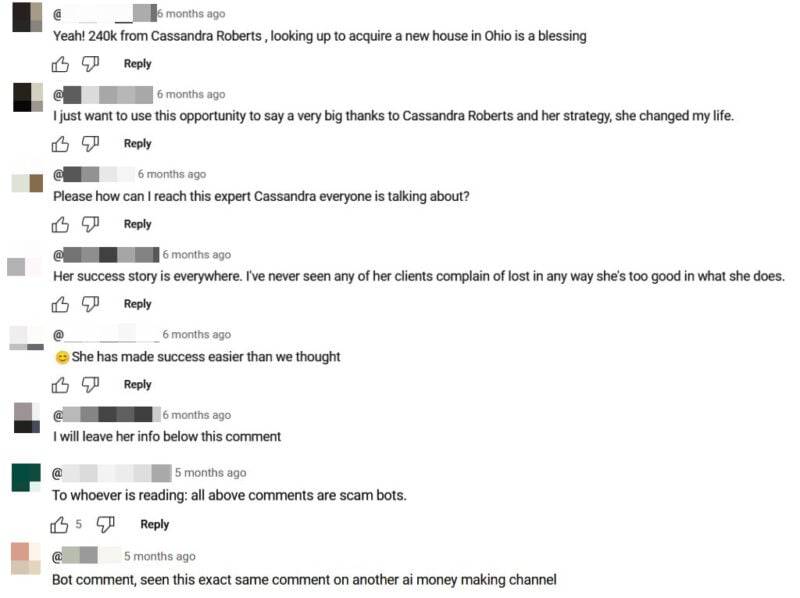
Cryptocurrencies are particularly vulnerable to this manipulation. AI bots flood social media with positive commentary about specific coins, flood comment sections, inundate news articles with hype, and even deploy deepfake technology to artificially inflate demand.
Spotting Fake News and False Information
You'll need to do your own research to verify information accuracy. This means refusing to accept claims uncritically and actively searching for clues. Here's what you can do:
- Identify fake news: Check the publication's history and cross-reference claims with trustworthy sources before accepting them as fact.
- Recognize fake comments: Artificial comments typically express extreme agreement or disagreement and repeat specific talking points robotically.
- Spot fake posts: Posts with unusually high engagement (likes or shares) relative to their comments may be amplified by bot networks.
Large-Scale AI-Powered Romance Scams (Pig Butchering)
Pig butchering scams work by building romantic or friendly trust with a target, then steering them toward fake investment opportunities. Now imagine AI capable of maintaining extended, coherent conversations with anyone on any topic. Welcome to large-scale romance fraud.

This typically happens on dating apps and social media. Bot accounts use convincing fake profiles to contact potential victims. They gradually build emotional trust through extended conversations, then transition the discussion to lucrative-sounding financial schemes—cryptocurrency, forex trading platforms, or other bogus investments.
Recognizing Romance Investment Fraud
Knowing who you're investing with and what you're investing in is basic due diligence for any investment. These same principles apply to AI-powered romance scams:
- Be suspicious if a stranger suddenly pushes investment opportunities that sound too good to be true. That instinct exists for a reason.
- Try arranging an in-person meeting or video call to confirm they're real. You can also reverse-image search their profile photo to ensure it hasn't been stolen.
- Independently verify the investment platform. Look for reviews, regulatory certifications, and confirm it's registered with financial authorities in your country.
Staying vigilant and keeping yourself informed remains your best defense against sophisticated, AI-powered fraud schemes.
Description: Learn to spot and defend against deepfakes, AI phishing attacks, fake reviews, and other sophisticated scams reshaping online fraud.
Related Articles
- The Best AI Apps for iPhone in 2026
- How AI Will Transform Work: The Next Measure of Enterprise AI Success
- How to Import Google Slides into Google Vids and Create Professional Videos
- How to Use Perplexity's Learn Step by Step Mode: A Complete Guide
- How the /goal Command Transforms Claude Code's Workflow

No Comment to " How to Protect Yourself From AI-Powered Scams Taking Over the Internet "