7 Classic Machine Learning Algorithms That Remain Essential in the AI Era
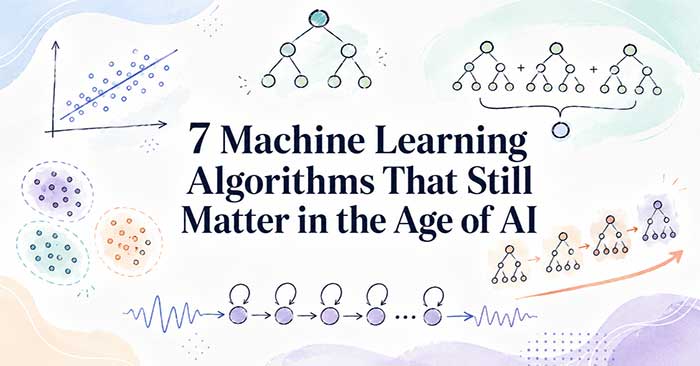
The explosion of generative AI has created a dangerous misconception: that every problem should be solved with a Large Language Model. The reality couldn't be more different. For tasks like time series forecasting, image classification, or predictions on tabular data, a traditional machine learning model often delivers faster results, lower costs, and simpler deployment than building an entire complex AI system from scratch.
This is precisely why classical machine learning algorithms remain cornerstones of modern data science. What separates a skilled data scientist from the crowd isn't always using the newest model—it's knowing which model fits the job. Here are seven machine learning algorithms every data scientist should master, along with how they work and Python examples.
1. Linear Regression
Linear Regression stands as one of the oldest yet most widely-used algorithms for predicting continuous values. You'll encounter it constantly in real-world applications: forecasting property prices, estimating monthly revenue, or predicting energy consumption.
The mechanics are straightforward. The model learns the relationship between input features and target values, then fits a line that minimizes the gap between predicted and actual values. During training, it also determines how much each feature influences the final result, making those weights available for predictions on new data.
from sklearn.linear_model import LinearRegression

model = LinearRegression()
model.fit(X_train, y_train)

y_pred = model.predict(X_test)
In this example, fit() trains the model on your training dataset, while predict() applies the learned parameters to make predictions on test data.
Linear Regression shines because it's blazingly fast, trivial to implement, and produces highly interpretable results. It's the go-to baseline model before experimenting with more complex algorithms.
2. Logistic Regression
Despite the name, Logistic Regression solves classification problems, not regression. It's the standard choice for binary outcomes: spam detection, customer churn prediction, fraud detection, or any yes/no scenario.
Rather than predicting a continuous value, Logistic Regression estimates the probability that a sample belongs to each class, then uses that probability to assign the final label.
from sklearn.linear_model import LogisticRegression

model = LogisticRegression()
model.fit(X_train, y_train)

y_pred = model.predict(X_test)
A nice feature of scikit-learn's implementation is that Logistic Regression includes built-in regularization to prevent overfitting.
It remains one of the strongest baseline models for classification tasks. Fast training, easy interpretation, and solid performance across diverse datasets make it indispensable.
3. LightGBM
LightGBM is a Gradient Boosting algorithm developed by Microsoft, optimized specifically for tabular data. It's the top choice in countless machine learning competitions.
The algorithm builds decision trees sequentially. Each new tree focuses on correcting the errors made by previous trees, and their combined predictions form the final output.
What's interesting here is LightGBM's Histogram-based Learning approach. Instead of processing individual continuous values, it groups data into bins. This dramatically reduces memory consumption and accelerates training on large datasets.
from lightgbm import LGBMClassifier

model = LGBMClassifier()
model.fit(X_train, y_train)

y_pred = model.predict(X_test)
The example above uses LGBMClassifier for classification tasks. For regression problems, LightGBM provides LGBMRegressor.
LightGBM also supports parallel, distributed, and GPU training, making it exceptionally effective for handling massive datasets efficiently.
4. XGBoost with Histogram Trees
XGBoost is arguably the most famous Gradient Boosting algorithm in the machine learning community and remains wildly popular for classification, regression, and ranking tasks.
Like LightGBM, XGBoost builds decision trees iteratively. Each successive tree attempts to fix mistakes made by the current model, progressively improving overall accuracy.
Rather than relying on a single decision tree, XGBoost combines many small trees into one powerful ensemble with exceptional predictive accuracy.
from xgboost import XGBClassifier

model = XGBClassifier(tree_method="hist")
model.fit(X_train, y_train)

y_pred = model.predict(X_test)
The parameter tree_method="hist" enables XGBoost to use histogram-based tree construction, speeding up the process of finding optimal split points and improving training efficiency.
Thanks to its flexibility, stability, and exceptional performance on tabular data, XGBoost remains the top choice for countless data scientists.
5. Random Forest
Random Forest is a celebrated ensemble learning algorithm that combines multiple decision trees instead of relying on just one.
During training, each tree learns from a different subset of data and features. The final prediction aggregates results from all trees combined.
For classification, trees vote on the class label. For regression, the final prediction is the average of all tree outputs.
from sklearn.ensemble import RandomForestClassifier

model = RandomForestClassifier(
    n_estimators=100,
    random_state=42
)

model.fit(X_train, y_train)

y_pred = model.predict(X_test)
In this example, n_estimators=100 means the model will build 100 decision trees.
Random Forest is refreshingly simple to use, performs well across diverse datasets, and offers a valuable bonus: it ranks the importance of each feature. This helps you understand which factors matter most for predictions.
6. Long Short-Term Memory (LSTM)
LSTM is a variant of Recurrent Neural Networks (RNNs) designed specifically for sequence data processing.
Unlike traditional machine learning algorithms, LSTM processes data step-by-step through time, maintaining an internal memory state through mechanisms called "gates." These gates decide what information to retain, update, or discard.
This capability allows LSTM to leverage previous observations to improve future predictions. It's ideal for tasks like sales forecasting, traffic prediction, sensor data analysis, and general time series problems.
from tensorflow import keras
from tensorflow.keras import layers

model = keras.Sequential([
    keras.Input(shape=(X_train.shape[1], X_train.shape[2])),
    layers.LSTM(64),
    layers.Dense(1)
])

model.compile(
    optimizer="adam",
    loss="mean_squared_error"
)

model.fit(X_train, y_train, epochs=20)

y_pred = model.predict(X_test)
Here, the LSTM(64) layer contains 64 LSTM units processing the data sequence, while Dense(1) outputs a single prediction value.
LSTM data typically follows the format samples × time steps × features. Though powerful at capturing complex temporal patterns, LSTM demands more data and computational resources than traditional machine learning algorithms.
7. K-Means Clustering
Unlike the algorithms above, K-Means is an unsupervised learning technique—it groups similar data points together without requiring labeled training data.
The algorithm starts by selecting cluster centers (centroids). Each data point gets assigned to the nearest centroid, then centroids are recalculated based on their assigned points. This process repeats until clusters stabilize.
from sklearn.cluster import KMeans

model = KMeans(
    n_clusters=3,
    n_init=10,
    random_state=42
)

clusters = model.fit_predict(X)
In this example, n_clusters=3 tells the model to create three clusters, while n_init=10 runs the algorithm 10 times with different initializations and picks the best result.
K-Means excels at customer segmentation, finding behavioral groups, and uncovering hidden patterns in unlabeled data. The main limitation: you must specify the number of clusters beforehand.
Conclusion
These seven algorithms remain widely deployed in modern AI systems for one simple reason: they work.
Even in production environments, many data scientists prefer traditional machine learning because these models train fast, deploy easily, and require far less CPU, memory, and infrastructure than generative AI systems.
Not every problem needs a Large Language Model or generative AI. For specialized tasks, a simple machine learning model can outperform complex systems without requiring fine-tuning of billions of parameters or building elaborate AI infrastructures.
Ultimately, the most important skill for any data scientist isn't always picking the newest model—it's selecting the right model for the job at hand.
Description: Generative AI dominates headlines, but traditional ML algorithms still power most real-world solutions. Here are seven you need to master.
Related Articles
- Using AI to Write Product Descriptions: A Proven Strategy to Boost Customer Engagement and Sales
- Managing AI Coding Agent Tasks Effectively: A Practical Workflow Guide
- Build Your Own Custom AI Voice with NoteGPT's Voice Designer
- Master Professional Email Replies with an AI Writing Assistant
- How to Extract Image Prompts from Any Picture for AI Generation

No Comment to " 7 Classic Machine Learning Algorithms That Remain Essential in the AI Era "