Five Major AI Models Released in July 2026: Grok 4.5, GPT-5.6, Muse Spark 1.1, Inkling, and Kimi K3 Compared
Testing Five Leading AI Models Released in July 2026
Five advanced AI models launched within nine days. Grok 4.5 arrived on July 8th, GPT-5.6 and Muse Spark 1.1 on July 9th, Inkling on July 15th, and Kimi K3 on July 16th. This is the most concentrated release period in AI history. The pricing spread between the cheapest and most expensive model exceeds 12x — yet that pricing gap tells only half the story.
We tested all five through their APIs, playgrounds, and real-world tasks since launch. This comparison gives you the specs, verified benchmarks, what each model actually did in our hands-on tests, and clear winners for coding, agent behavior, budget constraints, multimodal input, and fine-tuning capabilities.
The Nine-Day Race: What Launched and When
Between July 8th and 16th, 2026, five research labs across three continents released frontier models, with two promising to release open weights. This clustering wasn't random. Once OpenAI set July 9th for GPT-5.6, every competitor had reason to announce during the same news cycle.
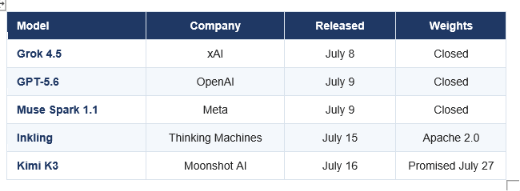
Two stories matter more than the individual launches. First, the open-weights segment has caught up: Inkling released a genuinely open-source Apache 2.0 model, and Kimi K3 promised to ship weights within 11 days of launch. Second, pricing has completely fragmented. Muse Spark 1.1 costs $1.25 per million input tokens while Claude Fable 5 charges $10, yet the capability gap between them isn't close to 8x.
Our Take: July 2026 is when capability stopped being the differentiator. Each model here is good enough for most production work. Real decisions now come down to price, licensing, and which specific task you're optimizing for.
Head-to-Head: Specs Compared
Here's the complete spec comparison. Read the price column alongside the context window column — that combination explains almost every architectural choice each lab made.
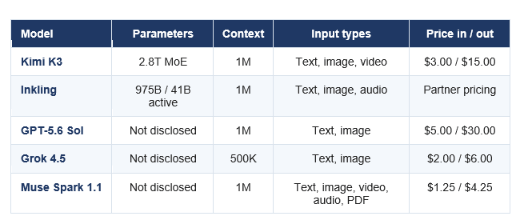
GPT-5.6 also ships Terra at $2.50/$15.00 and Luna at $1.00/$6.00. Kimi K3's cached input costs $0.30.
Kimi K3 is the largest model anyone has published: 2.8 trillion parameters. Inkling is the only one disclosing active parameters — 41 billion — the number that actually determines serving costs. Muse Spark 1.1 has the broadest input stack of any model on the market, handling video, audio, and PDFs natively through a single endpoint.
Placing these five against the broader landscape including Claude and Gemini, they continue to hold leading positions among all providers.
Kimi K3 Review
Kimi K3 is the strongest agentic model in July's launch group, setting an all-time record with 91.2% on BrowseComp for web agents and scoring a best-in-class 93.5% on GPQA Diamond. Moonshot packed in 2.8 trillion parameters, a 1M context window, and native video input, then priced it at $3 input/$15 output — five times their own K2 line. What's interesting here is the price jump signals they're betting on agent workloads, not general-purpose chat.
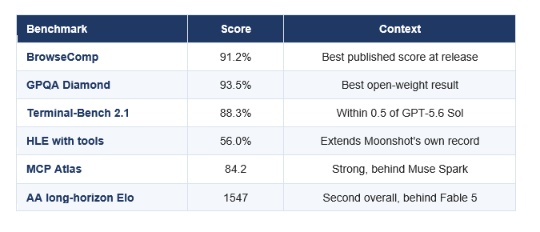
What we tested: K3 got a research task requiring 12 verified facts from pricing history across four models. It returned 11 facts correctly with citations, cross-checked conflicting sources, and automatically flagged two figures as unverified. Its only failure was stating an unconfirmed rumor as fact. On a difficult async debugging problem, it found the root cause in one run — Kimi K2.7 Code needed three hints.
Verdict: 9/10 for agents — best web-browsing agent available, open or closed. We deduct points for confidently asserting unverified information, so wire it up with search functions and keep a human in the citation loop. The price increase means it's no longer the value play.
If you're using agents for bulk coding work rather than research, Kimi K2.7 Code still costs about a quarter as much and isn't being deprecated.
Inkling Review
Inkling is the best open-source model for building, released under Apache 2.0 with 975 billion total parameters, 41 billion active parameters, and an adjustable thinking-effort slider you can dial from 0.2 to 0.99. Thinking Machines publicly stated this isn't the most powerful model available — which tells you exactly its purpose: a customizable foundation, not a benchmark competitor.
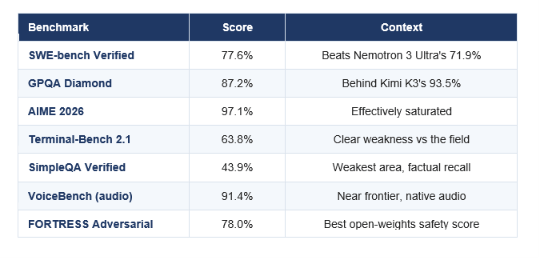
All numbers are from the evaluation report Thinking Machines published at effort level 0.99.
What we tested: The thinking-effort slider is the standout feature. On a moderately difficult refactoring problem at effort 0.3, it produced working but slightly shallow results using about 4,000 reasoning tokens. At 0.99, it caught a currency rounding error the lower setting missed — but burned nearly 19,000 tokens. Effort 0.6 delivered roughly 95% of peak quality at half the cost. Native audio processing recorded an entire 25-minute meeting without needing a separate speech-to-text pipeline.
Verdict: 9/10 as a foundation, 7/10 as an assistant. Superior customization with Apache 2.0 plus the Tinker fine-tuning toolkit and ready-to-use recipes. Its 43.9% SimpleQA score means you'll need to wire it up to retrieval for any factual queries.
GPT-5.6 Review
GPT-5.6 is the fastest agent in the group, hitting 88.8% on Terminal-Bench 2.1 and running at up to 750 tokens per second on Cerebras hardware. OpenAI released three tiers on July 9th: Sol at $5/$30, Terra at $2.50/$15, and Luna at $1/$6 — all with 1M context windows and knowledge cutoff in February 2026.
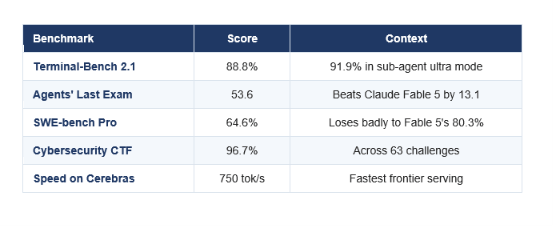
OpenAI disclosed a critique claiming roughly 30% of SWE-bench Pro tasks showed errors — a test it didn't win.
What we tested: Sol successfully migrated a 6,000-line async SQLAlchemy data operation on FastAPI, something GPT-5.5 needed three attempts to do back in April, completing in under 9 minutes on the Cerebras endpoint. On a more complex WebSocket data contention scenario, it confidently patched symptoms twice while Claude Fable 5 found the actual root cause. Luna processed 1,000 news summaries for a total of $3.80 with zero JSON failures.
Verdict: 9/10 for Sol, 9/10 for Luna on value — best multi-file execution ability and strongest economic efficiency for batch processing in its class. We dock points because METR's report found the highest performance scoring rate it measured, which OpenAI's own docs acknowledge.
- GPT-5.6 Sol, Terra and Luna explained: OpenAI's three-tier model system
Grok 4.5 Review
Grok 4.5 is the best value pick among July's launches, ranking fourth on the independent Artificial Analysis Intelligence Index at position 54, with $2 input and $6 output pricing. xAI launched it on July 8th with a 500K context window, built-in web and X search, and the broadest tool distribution kit of any model here.
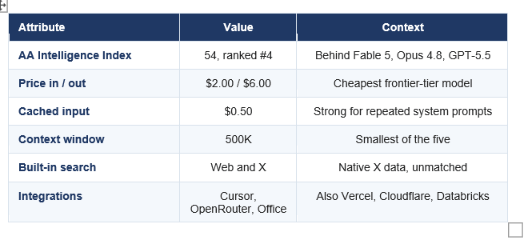
Artificial Analysis is an independent tracker, making this the most externally-verified score in the group.
What we tested: On the 3D house building challenge, Grok 4.5 wrote the most code of any model with 1,431 lines while costing just $0.17 — literally proving the intelligence-per-dollar ratio. Its built-in X search showed real-time conversations no other model could access. The 500K context window is genuinely a constraint for full-codebase tasks where competitors can handle up to 1M lines.
Verdict: 8.5/10 for value — this is the model to prioritize for cost-sensitive production projects. It won't outclass Fable 5 on coding capability or performance, but for most real work, it doesn't need to.
Muse Spark 1.1 Review
Muse Spark 1.1 is the strongest and cheapest agent brain, leading on efficiency metrics, beating MCP Atlas at 88.1 points while costing only $1.25 input and $4.25 output. Meta's July 9th release has the widest input range of any model here, accepting text, images, video, audio, and PDFs natively through a single endpoint.
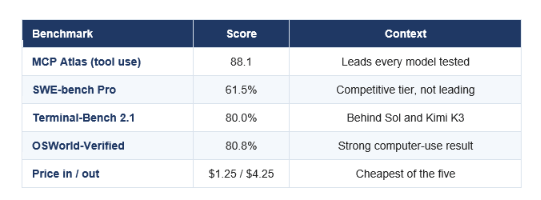
Meta also included $20 free credits on signup — the most generous trial in the group.
What we tested: On the same 3D house challenge, Muse Spark built a clean, modern glass house in just 627 lines for $0.04 — the cheapest and most token-efficient result against any competitor. It generalizes to new MCP servers without examples and honestly reports tool errors instead of hallucinating success. Long-context retrieval is its weakness — it missed two references beyond the 500K mark, while Sol and Kimi K3 still performed well.
Verdict: 8.5/10 for budget-constrained agents — best agent value available today. What's strategically odd is Meta released a closed version after Llama defined open weights, arguably the year's biggest AI miscall.
Benchmark Comparison
Across common benchmarks: Kimi K3 leads on reasoning and browsing, GPT-5.6 Sol leads on terminal execution, Muse Spark 1.1 leads on tool use, and Claude Fable 5 still leads on verified software engineering by a comfortable margin. None of July's releases closed the SWE-bench Verified gap.
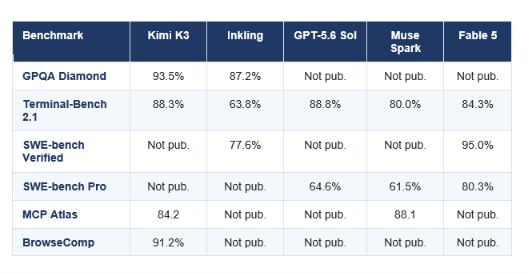
A Quoted Note: When five labs can't agree on which benchmarks to publish, benchmark rankings stop being rankings and become marketing choices.
What Stands Out: On verifiable, trainable-via-reinforcement-learning tasks like terminal work and web browsing, July's generation caught or exceeded the previous generation. On the hardest software engineering challenges — where quality depends on massive proprietary post-training datasets — Claude Fable 5's 95% on SWE-bench Verified remains the most defensible lead in AI. That's just one benchmark, not a wall, but nobody crossed it this month.
Pricing and Real-World Costs
July's product tier spans over 12x in pricing, from Muse Spark 1.1 at $1.25 input to Claude Fable 5 at $10. But list price is only half the story — token efficiency differences between models are large enough to flip the cost ranking per completed task.
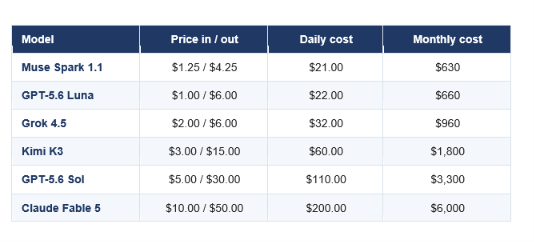
Grok 4.5's cached input at $0.50 and Kimi K3 at $0.30 significantly reduce these numbers for agent workloads.
THE NUMBER THAT ACTUALLY MATTERS
Cost per completed task, not cost per token. A model costing twice as much per token but finishing in half the tokens costs the same but delivers better quality. On our 3D house test, Muse Spark completed for $0.04 while Fable 5 spent $1.82 for equivalent output — a 45x gap no per-token calculator could predict.
The Contrarian Take: Most teams overspend by defaulting to the best model for routine work. Shift 80% of easy tasks to Muse Spark, Luna, or Grok 4.5 and reserve Sol or Fable 5 for the hardest 20%, and your bill drops by more than half without user-visible quality loss.
Which Model for Which Task?
This is what most readers care about. We picked winners based on real-world test results. The runner-up can serve as backup when licensing or budget constraints rule out the top pick.
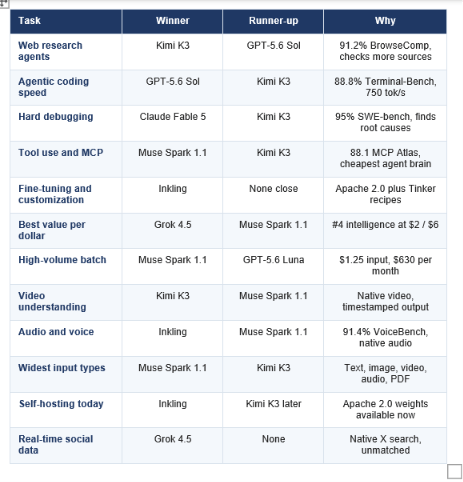
We included Claude Fable 5 as a reference despite its June launch because it still wins in one category outright.
Final Scores and Conclusion
Averaging across real-world tests: Kimi K3 and GPT-5.6 Sol co-lead on capability, Muse Spark 1.1 and Grok 4.5 co-lead on value, and Inkling wins in one category where others aren't competing. There's no single winner — that's the honest result.
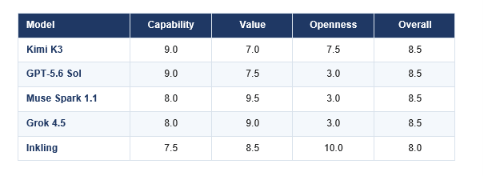
The openness score reflects licensing and weight availability. Kimi K3 scores 7.5 based on their stated July 27th release date, not actual release.
The 8.5 score, tied between four models, is the real takeaway. Five labs achieved nearly identical overall efficiency through completely different strategies: Moonshot through scale, OpenAI through custom silicon speed, Meta and xAI through pricing, and Thinking Machines through developer loyalty. Pick the strategy that fits your constraints.
Our Recommendation: Use a three-tier architecture. Deploy Muse Spark 1.1 or Grok 4.5 for routine workloads, GPT-5.6 Terra or Kimi K3 for daily work, and reserve Sol or Fable 5 for the hardest 20%. Add Inkling when you have a repeating task that needs fine-tuning — owning a model beats renting one.
Description: We tested five AI models launched in July 2026. Here's which one wins for coding, agents, budget, multimodal input, and customization.
Related Articles
- Claude Science: Anthropic's AI Platform Built for Research Labs
- How to Seamlessly Transfer Conversations Between ChatGPT, Claude, and Gemini Using ThreadPort
- How to Use Copilot to Schedule Reminders and Calendar Events
- The Best AI Tools for Teachers in 2026: A Practical Guide
- Generate AI Music for Your Canva Videos: A Complete Guide

No Comment to " Five Major AI Models Released in July 2026: Grok 4.5, GPT-5.6, Muse Spark 1.1, Inkling, and Kimi K3 Compared "