GLM 5.2: The Open-Weight Model That's Outperforming GPT-4.5 on Code and Design Tasks

Here's something worth paying attention to: GLM 5.2 from ZhipuAI combines a massive 1-million-token context window with MIT licensing and genuine strengths in programming and design tasks—all at significantly lower costs than the major closed-source alternatives. This isn't just another open-weight model trying to compete on price alone. It's a legitimately competitive option for real production work.
What is GLM 5.2, and Where Did It Come From?
The GLM (General Language Model) family has been developed by ZhipuAI since at least 2021, rooted in academic research at Tsinghua University. The lineage spans multiple generations—GLM-130B, GLM-4, GLM-4-Long, and the reasoning-focused GLM-Z1 series—with a consistent commitment to releasing commercially usable open-weight versions.
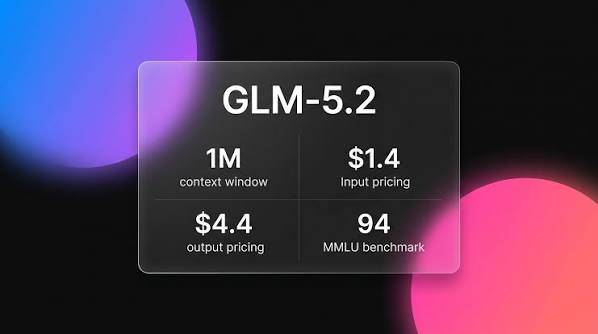
GLM 5.2 is the latest iteration. It's a dense transformer model trained on multilingual data with particular emphasis on coding, mathematics, and long-document reasoning. Unlike many models that claim to be "open" in name only, GLM 5.2 ships under an MIT license. That means you can use it commercially, modify it, and redistribute it without the typical restrictions.
ZhipuAI positions this as a direct alternative to cutting-edge closed models—not as a cost-saving compromise, but as a genuine competitor on the metrics that matter most for real application work.
Benchmark Performance: Code and Design Tasks
The headline claim—that GLM 5.2 outperforms GPT-4.5 on design and coding benchmarks—deserves careful scrutiny. What's interesting here is that "outperforming" a model depends entirely on which benchmarks you're looking at, and AI benchmarking is notoriously easy to manipulate. But the data is worth examining seriously.
Here's the performance picture across the benchmarks that matter most to developers:
Coding Benchmarks
On LiveCodeBench—which tests algorithmic problem-solving ability on competitive coding problems posted after the training cutoff—GLM 5.2 scores competitively with leading models. LiveCodeBench is especially useful because it's resistant to training data contamination; the problems are genuinely fresh.
On BigCodeBench, which evaluates more realistic programming scenarios (using actual libraries, working with APIs, completing multi-step tasks), GLM 5.2 shows strong results in Python, JavaScript, and SQL—the languages you actually use in production workflows.
On older but still widely-cited standards like HumanEval and MBPP, GLM 5.2 holds its own at the top tier among open-weight models and competes directly with top-tier GPT-4-class closed models on an apples-to-apples basis.
Design and Multimodal Tasks
In this context, "design benchmarks" mostly refers to tasks around generating code for UI components, producing structured output, and visual reasoning—not pure graphic design. GLM 5.2's performance on these tasks reflects strong structured generation and reliable adherence to complex formatting instructions.
On instruction-following benchmarks like IFEval, GLM 5.2 scores well. What's interesting here is how practical this is: most real AI workflows depend on models actually doing what you ask them to do.
Cost Comparison
This is where open-weight models like GLM 5.2 have a clear structural advantage. Running GLM 5.2 through providers like Siliconflow or self-hosting costs significantly less than GPT-4o or Claude Sonnet 3.7 via their native APIs.
For large workloads—code review pipelines, document processing, large-scale content generation—the cost difference is substantial. You get comparable output quality at a meaningfully lower per-token cost.
GLM 5.2 vs. GPT-4o vs. Claude: A Practical Breakdown

Here's a realistic look at how these models actually differ in performance.
| Benchmark | GLM 5.2 | GPT-4o | Claude Sonnet |
|---|---|---|---|
| Context Window | 1M tokens | 128K tokens | 200K tokens |
| License | MIT (Open) | Proprietary | Proprietary |
| Coding Performance | Leading Open-Weight | Strong | Strong |
| Multimodal Capabilities | Vision-Capable | Fully Multimodal | Vision-Capable |
| Cost | Low (Self-Hosted) | Medium-High | Medium-High |
| Vendor Lock-In | None | Yes | Yes |
| Reasoning | Competitive | Strong | Strong |
Best fit for GLM 5.2: Long-document processing tasks, cost-sensitive production deployments, organizations with data sovereignty requirements, and developers who need a model they can fine-tune and fully own.
Best fit for GPT-4o: Teams needing broad multimodal capabilities, native function calling, and tight integration with the OpenAI ecosystem.
Best fit for Claude: Tasks requiring careful instruction adherence, nuanced reasoning, and strong safety alignment out of the box.
No model is universally better. The right choice depends on your specific task, budget, and deployment constraints.
Real-World Use Cases for GLM 5.2
With a 1-million-token context window, MIT licensing, and strong coding performance, here are the workflows where GLM 5.2 actually shines:
Reviewing and Refactoring Large Codebases
You can load an entire repository—documentation, tests, configuration files and all—into a single context and ask the model to spot inconsistencies, suggest refactors, or plan migrations. This is cumbersome or impossible with shorter-context models.
Analyzing Legal and Financial Documents
Long contracts, legal briefs, and financial disclosures often run hundreds of pages. GLM 5.2's 1-million-token window lets you process them in one shot instead of chunking and splicing summaries back together.
Code Generation and Refinement
GLM 5.2's benchmark results on LiveCodeBench and BigCodeBench translate to solid real-world performance on the types of programming tasks developers actually do—not just toy algorithm problems. It handles multi-file context well, which matters for real project work.
Specialized Domain Applications
The real concern here is how often proprietary licenses lock teams into restrictive fine-tuning agreements. With MIT licensing, your team can fine-tune GLM 5.2 on proprietary datasets—medical records, legal precedents, company-specific codebases—and deploy the result without navigating complex licensing agreements. This is a significant advantage for heavily regulated industries.
Large-Scale Batch Automation
For workflows processing thousands of documents or API responses daily, the cost difference between GLM 5.2 (self-hosted or through affordable inference providers) and premium closed models can yield meaningful budget savings without significant quality trade-offs.
How to Access and Run GLM 5.2
There are several primary ways to use GLM 5.2:
Via ZhipuAI's API: The simplest approach for most developers. ZhipuAI offers API access at per-token rates significantly lower than major U.S. providers. The API is OpenAI-compatible, meaning most existing codebases using GPT models can switch over with minimal changes.
Self-hosting: Because GLM 5.2 is open-source under MIT licensing, you can run it on your own infrastructure. This requires GPU compute—exact hardware requirements depend on model size and quantization—but gives you complete data control and cost predictability.
Through third-party inference providers: Services like Siliconflow offer GLM model inference at competitive rates, balancing API convenience with cost efficiency.
Via no-code AI platforms: Some low-code and AI orchestration platforms have added GLM models to their rosters, making them accessible without infrastructure setup.
Description: GLM 5.2 delivers a 1M token context window, MIT license, and top-tier coding performance at a fraction of proprietary model costs.
Related Articles
- 5 Documents You Should Let AI Review Before You Regret It
- Subframe: The Hybrid Design-to-Code Tool Taking on Claude Design, Figma Make, and Replit
- What Is DeepSeek Harness? An Open-Source Agent Runtime Explained
- Build Your Own Custom AI Voice with NoteGPT's Voice Designer
- The 5 Best AI Search Engines in 2026

No Comment to " GLM 5.2: The Open-Weight Model That's Outperforming GPT-4.5 on Code and Design Tasks "