What Is Enterprise AI? A Complete Implementation Guide

There are fundamentally two ways to bring AI into a large corporation. You can start with a specific business problem and build your strategy from there. Or you can bulk-license a bunch of AI tools, roll them out company-wide, and hope for the best. I think you can guess which approach actually works.
Enterprise AI means leveraging artificial intelligence technologies — including Machine Learning, natural language processing, Generative AI, and AI agents — to crunch massive datasets and automate complex workflows across a large organization. Unlike consumer-facing AI tools, enterprise AI has to live alongside sprawling legacy systems, comply with strict security standards, and integrate with governance frameworks that would make most startups cry.
Below is everything you need to know about enterprise AI: what it actually is, how to implement it without creating chaos, and real examples of organizations already using it effectively.
What Exactly Is Enterprise AI?
Enterprise AI applies AI technologies — Machine Learning, natural language processing, Generative AI, and AI agents — to solve problems at organizational scale. The underlying tech is similar to what powers the consumer tools you already know, but enterprise AI is purpose-built to tackle the specific challenges large organizations face: processing enormous datasets, automating workflows across departments, and powering decisions that ripple through the entire company.
Operating at that scale introduces real complexity and risk. Enterprise AI needs to connect with dozens (or hundreds) of applications in your tech stack, handle sensitive data according to frameworks like GDPR and SOC 2, and give IT teams granular control over access, permissions, and functionality. It has to be secure, auditable, and compliant — no exceptions.
Here are the main ways enterprise AI creates business value:
- Data Analysis: Enterprise AI can sift through mountains of information from multiple sources, surfacing patterns, trends, and correlations that would take humans months or even years to spot manually.
- Process Automation: AI excels at repetitive, time-consuming tasks. Automation platforms like Zapier let you build end-to-end workflows across your entire tech infrastructure, freeing your team from tedious work and dramatically reducing human error.
- Predictive Analytics: By analyzing historical performance, customer behavior, and market data, enterprise AI can help forecast likely outcomes and flag potential risks before they materialize.
- Personalization at Scale: Enterprise AI can analyze individual customer behavior to deliver tailored recommendations, offers, and support across millions of users — something no human team could ever manage manually.
The Real Benefits of Enterprise AI
Deploying AI across a large organization is a serious investment, so it's worth asking what you actually get in return. Here are six areas where the payoff tends to show up most clearly.
- Dramatic Efficiency Gains: AI handles repetitive work that consumes huge chunks of your team's time — processing invoices, updating records across systems — freeing people to focus on work that actually requires human judgment.
- Lower Operating Costs: Automating manual processes cuts labor hours for routine tasks and minimizes costly errors. In logistics and manufacturing, predictive maintenance means less unplanned downtime and equipment failures.
- Faster, Smarter Decisions: Enterprise AI can analyze data across the organization in real time, letting leaders make decisions based on what's happening now, not what last quarter's report said.
- Better Customer Experience: AI-powered support can answer common questions 24/7, and personalization tools can adjust recommendations and offers for every customer at scale — something no team could do manually.
- Effortless Scaling: Once an AI-driven process works, it can handle 10x the volume without needing 10x more people. That applies to everything from customer requests to data processing.
- Stronger Risk Management: AI can continuously monitor transactions, systems, and data flows, detecting anomalies, potential fraud, or compliance issues before they become expensive problems.
7 Real-World Enterprise AI Use Cases
AI won't solve your business problems just because you bought software. First, you need to point it at specific challenges. Here are seven examples of how organizations are actually using enterprise AI.
1. AI for IT Operations
AI for IT Operations (AIOps) uses Machine Learning to monitor systems, catch problems before they become critical, and automatically fix issues or flag them for human review. Without it, you're stuck in an endless game of whack-a-mole: problems surface, systems slow, and your team scrambles to keep things running.
Here's what AIOps actually does:
- Smarter Data Analysis: AIOps platforms collect enormous volumes of IT data — far beyond what humans can process — then use Machine Learning to spot patterns that signal emerging issues and even predict incidents before they happen.
- Automation: AIOps handles repetitive tasks that drain engineering time, from routine maintenance to resolving common support tickets.
- Alert Fatigue Reduction: When systems drown in alerts, AIOps consolidates them, prioritizes genuine problems, and suggests solutions — so your team doesn't waste time chasing false alarms.
Instead of spending all day firefighting, your IT team can focus on preventing incidents in the first place. The result: less downtime, more stable infrastructure, and engineers actually building things that move the business forward.
Real Example: Remote, a global payroll services company with over 1,800 employees, was handling roughly 1,100 IT support requests monthly with just three people. By building AI-powered automation workflows through Zapier, that tiny team now operates at the capacity of a 10-person department. Across the company, Remote's automated processes handle 11 million tasks annually and save approximately $500,000 per year.
2. AI for Customer Service
AI for customer service handles the daily grind of support — answering FAQs, routing requests, finding answers that would otherwise eat up half your rep's day digging through documentation.
Here's what it brings to the table:
- Always-On Support: AI chatbots never sleep. They can handle basic questions and simple issues outside business hours, boosting customer satisfaction while reducing the support backlog during peak times.
- Faster Resolution: AI can analyze customer data to automatically route requests to the right department and suggest relevant resources to agents, cutting research time. Customers get faster answers, and your team handles more tickets.
- Personalization at Scale: Based on customer history and behavior, AI can recommend relevant products and optimal solutions. This personal touch builds loyalty across your entire customer base simultaneously.
- Data-Driven Insights: Every interaction becomes useful data. By analyzing sentiment and common questions, you spot trends, proactively fix recurring issues, and feed insights back into product development.
3. AI for Marketing
AI is a powerful tool for marketers. It can analyze customer data to refine targeting, speed up content creation, and personalize campaigns at a scale no human team could manage manually. The difference between AI-informed targeting and guesswork often shows up directly in ROI.
4. AI for Market Research
AI can process research data in hours instead of weeks — synthesizing competitive intelligence and surfacing trends your team might miss for another two quarters. Beyond crunching numbers, Generative AI also helps with the more abstract side of research: testing positioning angles and validating assumptions before you commit budget to them.
5. AI for Human Resources
AI handles most of the administrative HR grunt work: resume screening, generating hiring paperwork, and other tasks that chew up enormous amounts of recruiter time. That balance matters even more in growing companies where workload explodes faster than your HR team can expand.
6. AI for Engineering
Ask any engineering manager how their team spends its time, and you'll hear the same things: writing boilerplate code, documenting systems, debugging infrastructure built by people who left years ago. AI actually tackles a chunk of all three — which means more of your engineers' time goes toward building new things instead of maintaining old ones.
7. AI for Logistics
In logistics, small problems snowball fast: a truck arrives late, the dock backs up, the warehouse backs up, and customers end up with broken promises. Enterprise AI helps supply chains spot these issues early — or avoid them entirely — by processing the data your fleet and warehouse operations are constantly generating.
How to Actually Implement Enterprise AI Across Your Organization
AI is powerful, but it won't fix your business problems on its own. Successful implementation demands strategic thinking, clear communication, and a plan to handle the inevitable skeptics who think AI is just hype.
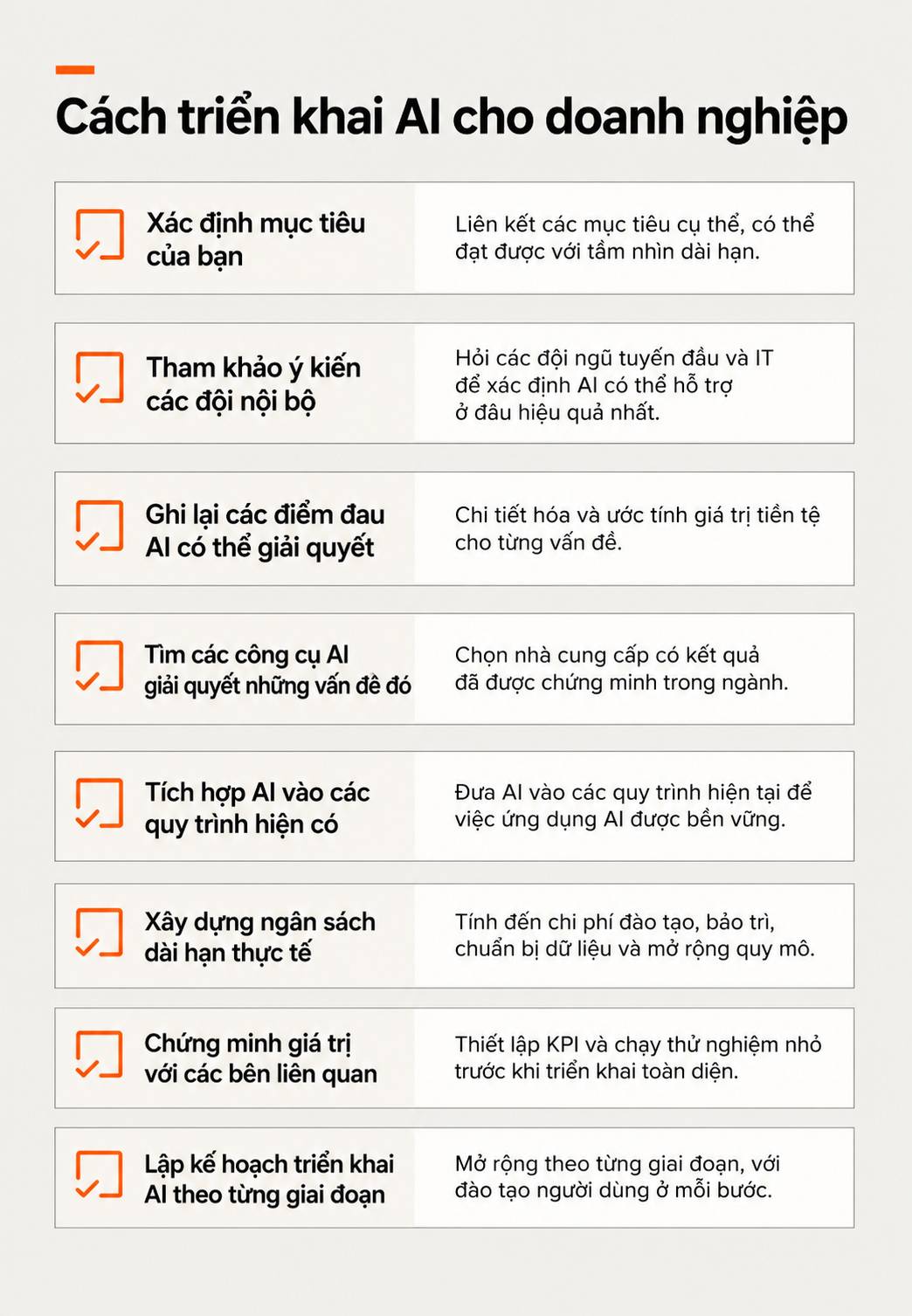
1. Define Clear AI Objectives
Start by listing the biggest problems AI can actually solve for your organization. Maybe that's streamlining logistics to cut costs, or making product decisions faster based on real data.
Be specific. Focus on achievable goals. And whatever you choose, connect it to your company's long-term vision — that connection is what will convince stakeholders later.
2. Consult Your Internal Teams
The people on the front lines know where the bottlenecks are, so get department managers and individual contributors involved in identifying where AI can help.
Talk to IT early to make sure any solution fits your infrastructure and security requirements. And encourage open conversation: transparent discussions reduce fears about job loss, and frontline workers often spot the best AI applications before leadership does.
3. Document the Problems AI Can Solve
Now get specific about which problems AI can tackle. Ask yourself:
- How much time is your team spending on repetitive manual tasks?
- Where is lack of data-driven insight causing costly delays or missed opportunities?
- Can you quantify the financial impact of these problems?
Put dollar signs on the problems whenever possible — quantifying them makes the potential ROI of any solution crystal clear.
4. Find AI Tools That Address Those Specific Problems
No single AI solution works for every scenario, so avoid chasing the latest trend. Focus on AI tools that directly solve the problems you've identified, and prioritize vendors with solid reputations in your industry and good integration with your existing tech stack.
5. Embed AI Into Existing Workflows
When AI lives in a separate app that people have to remember to open, adoption craters fast. Instead, integrate AI into the workflows your team already uses — like an AI step that auto-classifies support requests before they're routed, or an email draft that generates automatically when a sales call ends.
6. Budget Realistically for the Long Term
Look beyond the initial software purchase. Factor in deployment costs, AI training, data prep work, ongoing maintenance, and future scaling needs.
Investing in AI education for your workforce is essential too. This long-term investment will maximize the benefits you see over time.
7. Prove Value to Stakeholders
Data is your best friend here. Identify measurable KPIs before you deploy AI — things like cost savings or time-to-market. Then run a small pilot in a clearly defined area and start tracking performance against those KPIs. You'll have real before-and-after numbers to show.
While you're gathering your own evidence, case studies from similar companies in your industry can also build early confidence.
8. Plan Your Rollout Carefully
Once your pilot proves the concept, scale gradually instead of flipping a switch company-wide. Prioritize user training at every stage and use feedback from early adopters to smooth the process for teams coming later.
Description: Learn what enterprise AI is, how to deploy it effectively across your organization, and real-world use cases that actually drive ROI.
Related Articles
- 10 Strategies to Future-Proof Your Career in the AI Era
- Turn Long-Form Content Into Organized Notes With NoteGPT
- Open Google Docs Directly in ChatGPT: A Complete Guide
- Teaching AI to Remember Your Writing Style: A Self-Learning System
- GPT-6 Astra: Features, Performance Benchmarks, Pricing & How to Access

No Comment to " What Is Enterprise AI? A Complete Implementation Guide "