Hugging Face: The Python Ecosystem That Revolutionized AI Development

If you've spent any time exploring machine learning, generative AI, or digging through AI projects on GitHub, you've almost certainly encountered Hugging Face. You might have even downloaded a pre-trained model from their Hub, loaded a dataset, or followed a tutorial using their Transformers library—all without fully realizing that nearly the entire modern AI ecosystem revolves around this single platform.
Hugging Face has become indispensable to AI development workflows. Countless developers use it daily, yet many don't fully grasp just how profound its impact on the AI industry has become.
Here's what's interesting: Hugging Face isn't just another Python library for AI. It's an entire ecosystem that transformed how researchers share models, how engineers build AI applications, and how newcomers can experiment with cutting-edge machine learning without needing a PhD.
And here's the kicker—Hugging Face didn't invent the Transformer architecture. They didn't create BERT, GPT, or Llama. So why did it become the center of the AI universe?
To answer that, we need to go back to the time before Hugging Face existed.
How Difficult Was AI Development Before Hugging Face?
Picture this: you've just read a research paper describing a groundbreaking language model and want to try it yourself. Here's what the process typically looked like:
Read paper → Find GitHub repo → Clone code → Install dependencies → Download weights → Resolve version conflicts → Run model.
Sounds straightforward, right? In reality, it was a nightmare. Every research group built projects their own way. Some used TensorFlow, others PyTorch. Directory structures, config files, library versions, and model loading methods all differed. Just reproducing the results from a single paper could take hours—sometimes days.
It got worse when you wanted to try a different model. You essentially had to learn the entire new project structure from scratch because no common interface existed. As AI research accelerated, this fragmentation became a massive bottleneck, and the community desperately needed unified infrastructure.
Then Hugging Face arrived.
What Exactly Is Hugging Face?
Many people think Hugging Face is just the Transformers library. That's only part of the story. Transformers is one component within a much larger ecosystem.
Think of Hugging Face as a central hub, with the Hugging Face Hub serving as a repository for models, datasets, and AI applications. Surrounding this Hub are specialized libraries, each handling different stages of the machine learning development cycle.
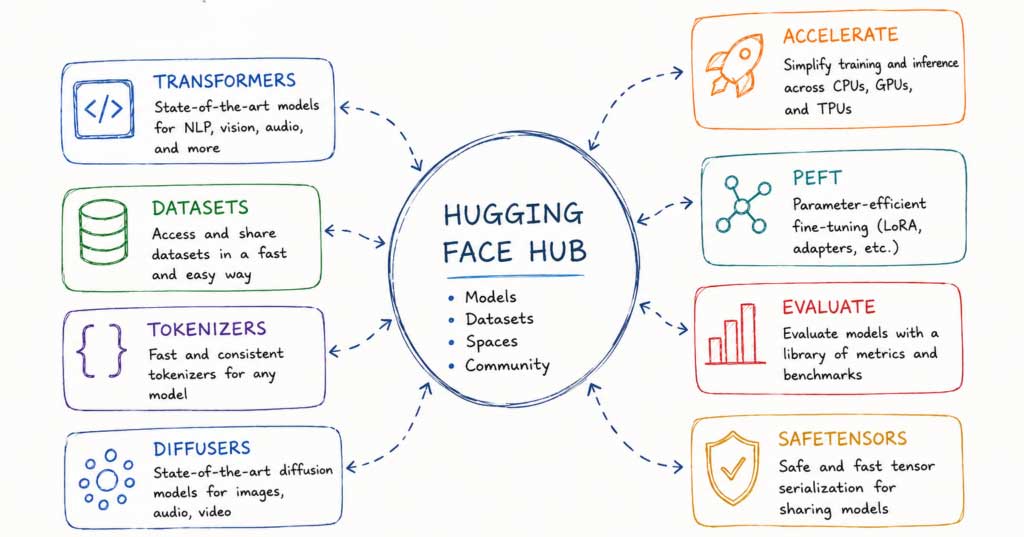
Today's Hugging Face ecosystem includes:
- Transformers: Access to thousands of pre-trained language and computer vision models.
- Datasets: Download and process machine learning datasets with ease.
- Tokenizers: Convert text into numerical representations with exceptional performance.
- Diffusers: Work with image, video, and audio generation models.
- Accelerate: Simplify distributed training across multiple GPUs.
- PEFT: Apply parameter-efficient fine-tuning techniques like LoRA.
- Evaluate: Standardized evaluation metrics for model assessment.
- Safetensors: A secure and faster model storage format compared to traditional alternatives.
With these components, developers can search, download, train, evaluate, and deploy AI models through a single unified interface instead of juggling multiple separate projects.
Hugging Face Hub—The "GitHub" for AI
If GitHub is where code lives, Hugging Face Hub is the dedicated home for AI resources. Currently, the Hub hosts:
- Hundreds of thousands of pre-trained AI models.
- Hundreds of thousands of datasets.
- Thousands of interactive AI applications (Spaces).
- Version-controlled code repositories.
- Documentation, model cards, and usage guides for each model.
Instead of hunting through GitHub repositories every time you want to test a new model, developers simply visit Hugging Face Hub. Each model comes with documentation, licensing info, version history, and usage examples—making model reuse exponentially simpler.
Transformers—Hugging Face's Most Famous Library
The standout component in the Hugging Face ecosystem is the Transformers library. Want to build a sentiment analysis system? A few lines of Python lets you leverage a pre-trained model immediately.
What's remarkable is everything happening behind those simple lines of code.
When you call the pipeline() function, the library automatically:
- Selects the appropriate model.
- Downloads the model if you don't have it locally.
- Loads the matching tokenizer.
- Allocates the model to memory.
- Converts text into tokens.
- Runs the model.
- Formats predictions into readable output.
This entire complex workflow stays hidden, letting developers focus on solving problems rather than wiring together individual components.
Transformers Isn't Just for Chatbots
A common misconception: Hugging Face only serves chatbots and language models. Actually, the Transformers library supports numerous AI tasks:
- Text generation.
- Question answering systems.
- Image classification.
For developers wanting more control, Hugging Face provides AutoModel, AutoTokenizer, and other components for direct model access instead of using pipeline().
These Auto classes automatically detect the right architecture—whether it's BERT, RoBERTa, or another Transformer variant—maintaining simplicity while offering flexibility.
Where Does the Data Come From?
Models are only half the equation. The other half is data. To address this, Hugging Face developed the Datasets library, providing access to thousands of public datasets through a unified programming interface.
With a single function call, developers can download, cache, and start working with datasets that previously required extensive preprocessing. Datasets also supports streaming, allowing you to process enormous datasets without loading everything into RAM.
Beyond Inference: Hugging Face Supports Training Too
Most people start with Hugging Face by running pre-trained models. But the ecosystem provides complete tools for training and fine-tuning. Libraries like Trainer, Accelerate, and PEFT simplify critical tasks including:
- Multi-GPU training.
- Mixed precision training.
- Parameter-efficient fine-tuning with LoRA.
This means developers can start on a laptop and scale to multi-GPU systems with minimal code rewrites.
Hugging Face didn't become the AI world's hub by owning the most powerful language model. Its greatest achievement lies in standardizing the entire AI workflow.
Hugging Face unified how we share, download, and use models, connecting thousands of independent research projects into one cohesive ecosystem.
Just as GitHub transformed code sharing and PyPI revolutionized Python package distribution, Hugging Face is doing the same for machine learning. It dramatically lowered barriers to AI access, accelerated research velocity, and made cutting-edge technologies accessible to millions of developers through just a few lines of Python.
Sometimes in science, the greatest innovation isn't creating something entirely new—it's making existing technology accessible to everyone else.
Description: Discover how Hugging Face became the central hub of modern AI development and why it's essential for machine learning projects.

No Comment to " Hugging Face: The Python Ecosystem That Revolutionized AI Development "