The 7 Best Web Crawling Tools and APIs in 2026 for AI and RAG Systems

People often mix up web scraping and web crawling, but they're actually quite different. Web scraping focuses on extracting data from a single webpage — you give it a URL and it pulls back the content in a clean, processable format. Web crawling goes further. Instead of stopping at one page, the tool starts from your initial URL and automatically follows links across an entire site to collect data everywhere. This approach works great when you need documentation, blog posts, product pages, help centers, or any content spread across multiple pages.
What's interesting here is how AI is reshaping web crawling. Instead of just returning raw HTML, modern platforms now support custom prompts, structured data extraction, Markdown and JSON output, integrated search, screenshots, and AI agent connections. This means you can ask an AI to grab specific information across an entire website and get back clean data ready for RAG systems, AI agents, data pipelines, or other AI applications.
Here are the 7 standout web crawling tools and APIs for 2026, covering both commercial services and open-source frameworks.
1. Olostep
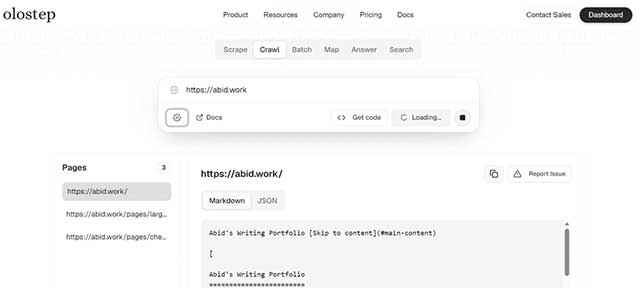
Olostep stands out as a top choice thanks to its Crawling API, which starts from one URL, automatically collects related pages, and returns clean data for AI applications. Rather than scraping pages individually, Olostep can scan an entire site and prepare data for RAG, research, monitoring, or structured information extraction workflows.
The real appeal is the combination of affordability, speed, and accuracy. It's particularly strong for technical documentation, blogs, product pages, help centers, and knowledge bases where information lives across multiple pages.
Beyond the API, Olostep also offers Model Context Protocol (MCP) Server, Agent Skills, and CLI tools, making integration smooth with AI programming tools like Claude Code, Cursor, Windsurf, VS Code, and various agent development workflows.
Best for: full-site data collection on a budget, AI agents, RAG systems, structured data extraction, and large-scale web data processing.
2. Firecrawl
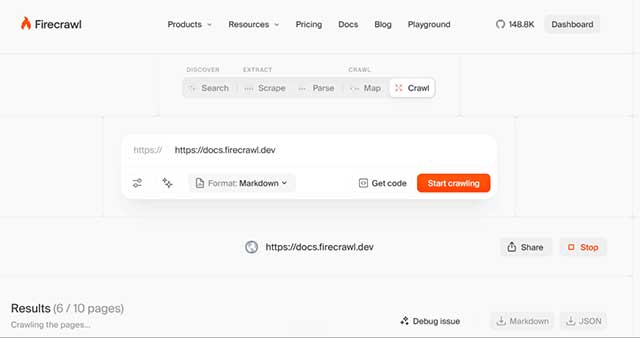
Firecrawl is one of the most popular web crawling APIs in AI circles right now. Its strength lies in the ability to crawl an entire website from a single URL and return cleaned, ready-to-use content for large language model (LLM) applications.
It's ideal when you need data from documentation, blogs, help centers, or knowledge repositories without building your own crawler. The output is optimized for direct integration into RAG systems, AI agents, or internal search tools.
From experience, Firecrawl and Olostep deliver comparable quality. Olostep has a cost advantage, while Firecrawl sometimes offers better speed or accuracy depending on the website.
Best for: document crawling, clean Markdown export, RAG systems, AI agents, and AI applications powered by website data.
3. ScrapeGraphAI
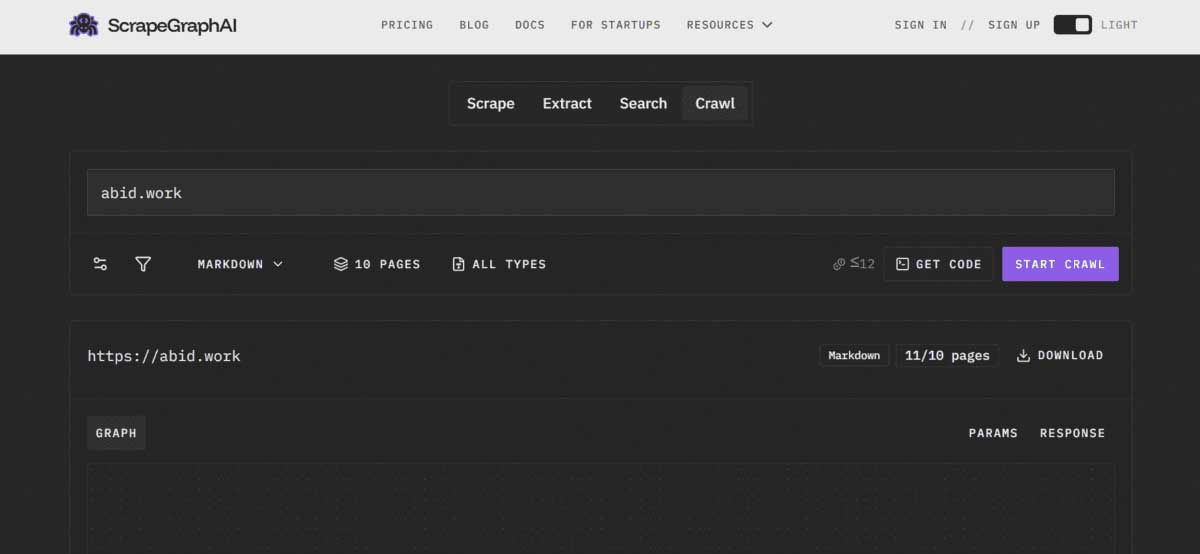
If you want an open-source solution that runs completely on your own machine, ScrapeGraphAI deserves serious consideration. It combines LLM technology with graph-based logic to extract data from websites and files (HTML, XML, JSON, Markdown).
The big tradeoff is setup complexity. You need to provide your own AI model through OpenAI, Groq, Azure, Gemini APIs, or run one locally with Ollama. This gives you more control but requires more configuration than services like Olostep or Firecrawl.
ScrapeGraphAI includes a CLI for scraping, multi-page crawling, searching, monitoring, and prompt-based extraction — great for local AI workflows.
Best for: open-source web crawling, local AI scraping, prompt-based extraction, structured JSON output, and custom pipelines.
4. Scrapling
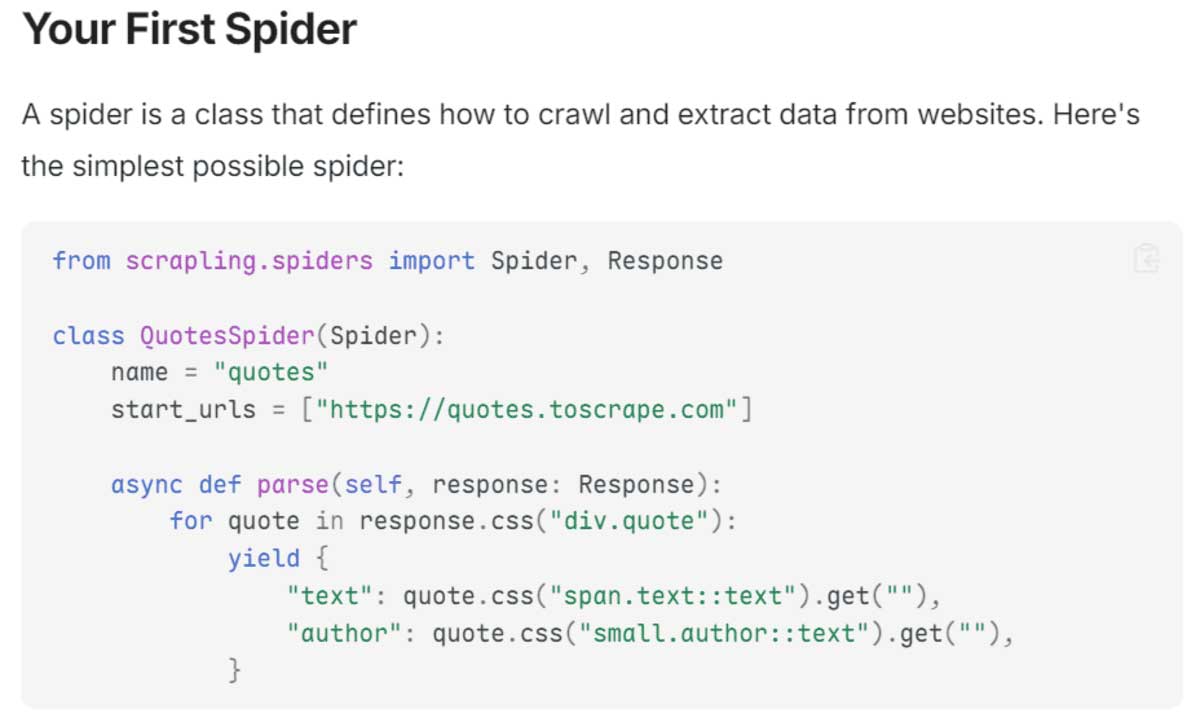
Scrapling is an open-source Python web crawling framework that handles everything from single-page scraping to full-site crawls. It's ideal if you want complete control over data collection instead of relying on commercial platforms.
The standout feature is the Adaptive Parser, which adjusts automatically when website layouts change. If a site updates its design, the tool finds the data again instead of breaking. Scrapling also supports spider frameworks, parallel crawling, pause-and-resume, and automatic proxy rotation.
The downside is you handle all deployment and operations yourself.
Best for: Python crawling framework, adaptive scraping, full-site crawls, spider workflows, and self-managed data pipelines.
5. Crawl4AI
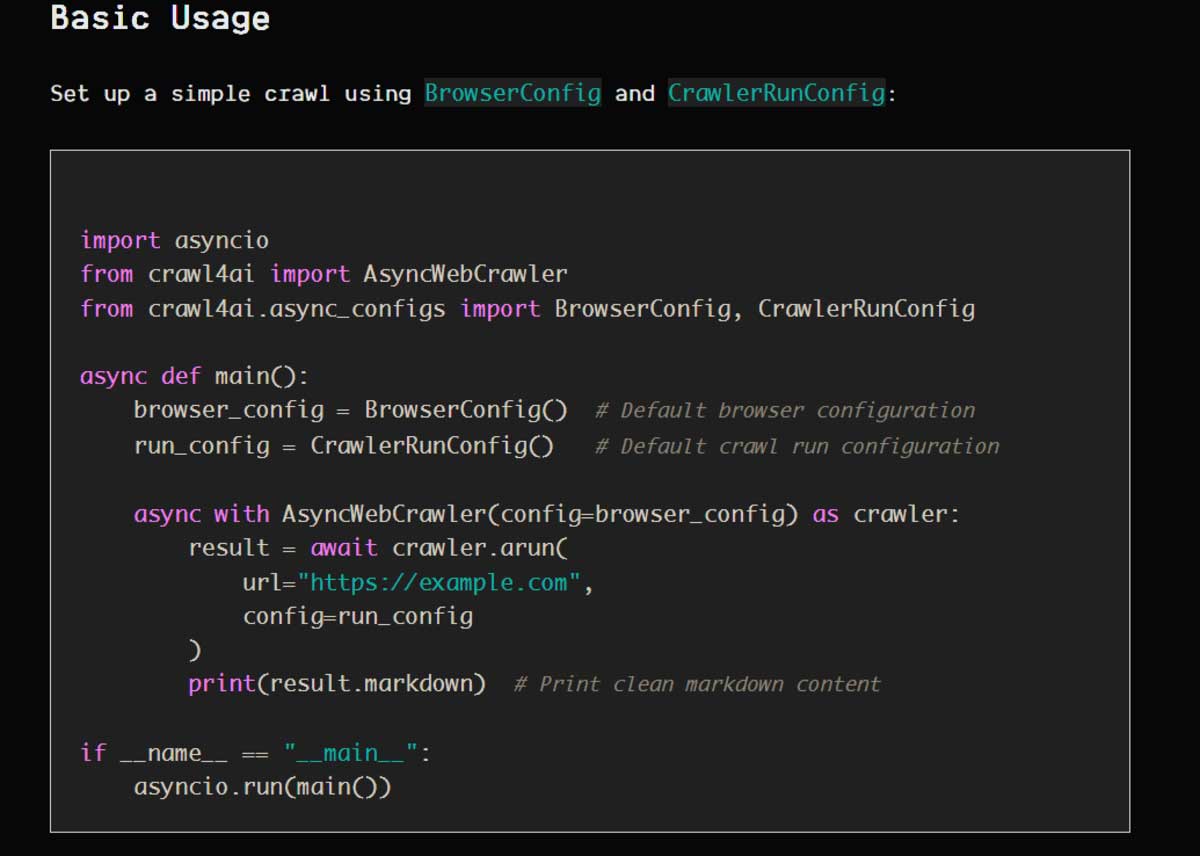
Crawl4AI is an open-source framework built specifically for AI applications. It converts entire websites into clean Markdown, making it perfect for RAG systems, AI agents, and data processing pipelines.
Compared to commercial APIs like Olostep or Firecrawl, Crawl4AI offers more control. You can handle JavaScript-heavy sites, run parallel crawls, configure proxies, manage sessions, and extract data via CSS selectors, XPath, or LLM prompts.
The tradeoff: you handle all deployment, scaling, error handling, and performance optimization yourself.
Best for: self-hosted AI crawlers, Markdown data for LLMs, RAG systems, AI agents, and custom data extraction workflows.
6. Scrapy
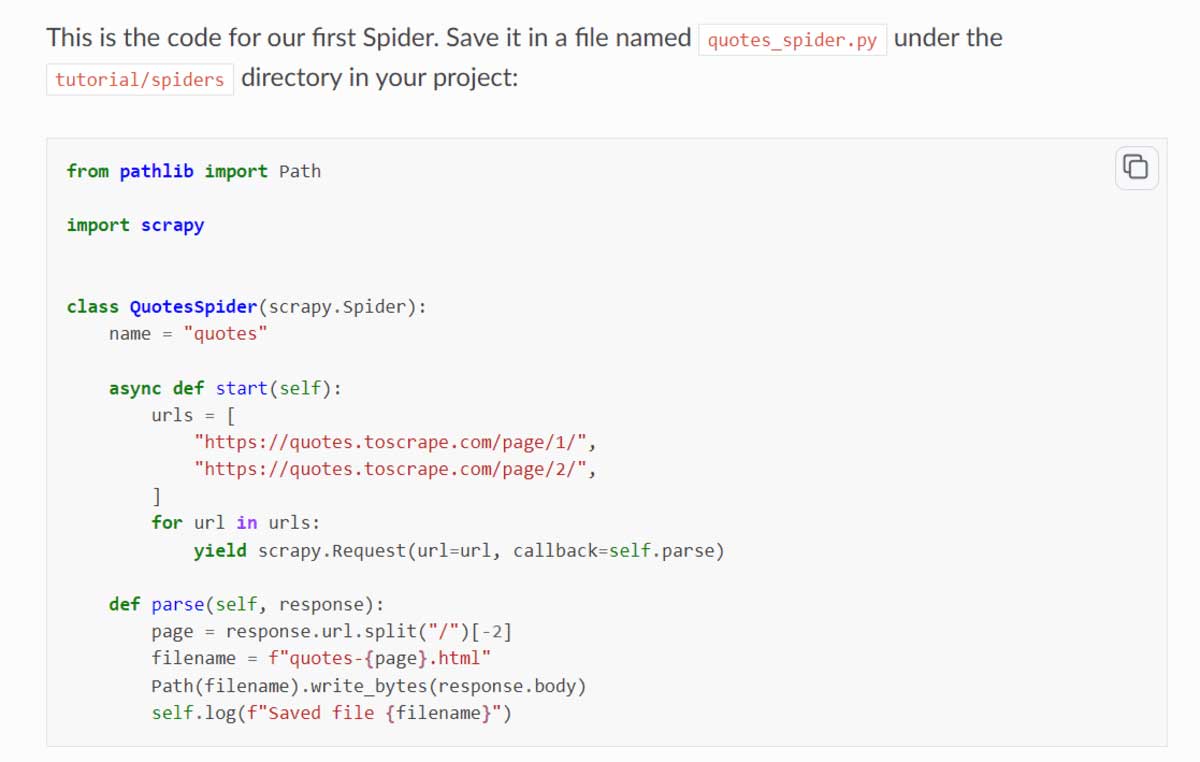
Scrapy is one of the oldest and most popular Python web crawling frameworks. It gives developers full control over spiders, requests, parsing, retries, data export, and processing pipelines.
This is a solid choice if you need to build specialized crawlers for websites with stable, repetitive structures.
The limitation: Scrapy wasn't designed with AI in mind from day one. If you want clean Markdown output, prompt-based extraction, or RAG-ready data, you'll need to integrate an LLM yourself.
Best for: custom Python crawlers, structured data extraction, large-scale crawling, and production-grade data processing systems.
7. Crawlee
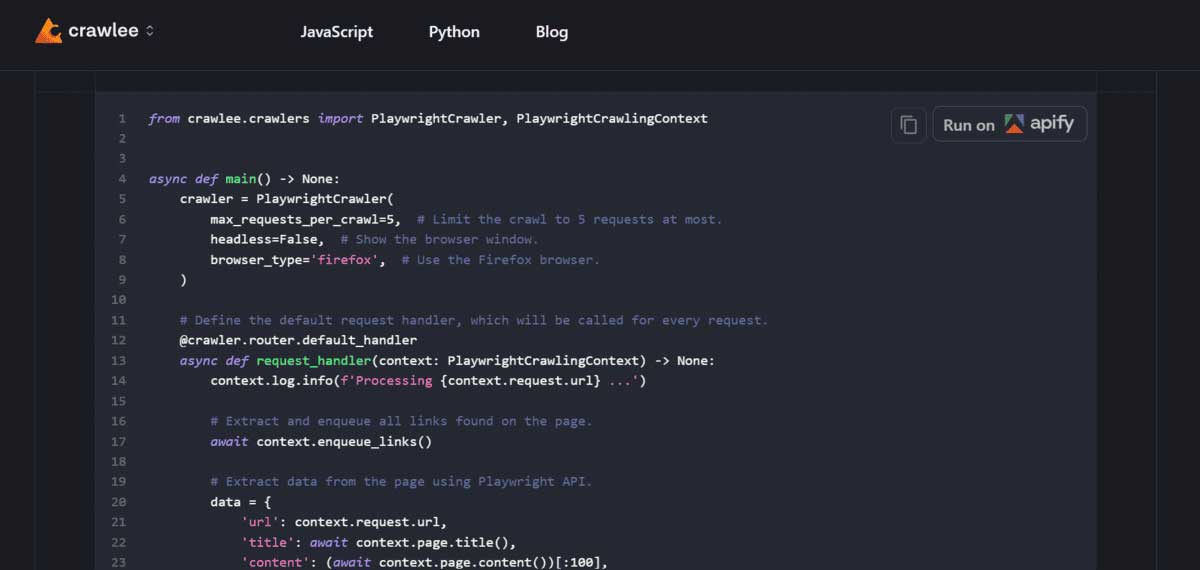
Crawlee is an open-source framework supporting JavaScript, TypeScript, and Python. It lets developers build custom crawlers without starting from scratch. It handles common challenges like link discovery, request queuing, retries, proxies, automated browser control, and data storage.
This works well if you need more control than a typical API but still want to leverage built-in components.
However, Crawlee is still a developer framework, not a plug-and-play service. You'll build and operate your own crawler.
Best for: custom crawlers for JavaScript, TypeScript, and Python, JavaScript-heavy sites, self-hosted systems, and large-scale data pipelines.
Summary
The right choice depends on how much control you want and how much time you can invest in setup.
If you prioritize ease of use, reasonable pricing, and strong AI agent integration, Olostep is worth serious consideration. Firecrawl also delivers excellent quality, especially for building RAG systems or AI applications that need clean website data.
For self-hosted solutions, ScrapeGraphAI is compelling thanks to its LLM integration and open-source foundation. Scrapling fits if you need a modern Python framework with adaptive capabilities when sites change. Crawl4AI optimizes for self-hosted AI applications, while Scrapy remains one of the most powerful frameworks for building production-grade Python crawlers. Finally, Crawlee suits development teams using JavaScript or TypeScript who want full control over their crawling infrastructure.
Whatever tool you pick, speed, accuracy, and easy integration into your workflow matter most. A great web crawler isn't just feature-rich—it helps you get clean data with minimum cost and effort.
Description: Compare top web crawling solutions for AI applications. From Olostep and Firecrawl to open-source frameworks like Scrapy and Crawlee.
Related Articles
- Where Did the Copilot Button Go? Here's Why It Disappeared from Your Office Apps
- How AI Is Transforming Content Marketing Success
- ChatGPT vs Meta AI: Which AI Chatbot Actually Wins?
- The Best AI Meeting Assistants: 5 Tools That Actually Save You Time
- Claude Pro vs API: Which Option Actually Makes Sense for You?

No Comment to " The 7 Best Web Crawling Tools and APIs in 2026 for AI and RAG Systems "