Getting Started with AI in 2026: A Beginner's Guide from Industry Experts

Whether you're dreaming of becoming an AI engineer or just want to stay relevant in a rapidly changing tech landscape, there's no better time than now to dive into artificial intelligence. This guide walks you through everything you need to know about learning AI in 2026—from practical advice for getting started to insider insights from industry professionals.
- 3 Key Benefits of AI for Business in the Coming Years
- AI May Reshape Jobs, But It Also Promises Better Lives
Quick Summary: Your AI Learning Roadmap for 2026
Short on time? Here's a condensed version of how to start learning AI effectively. Remember: mastering AI takes commitment, but with the right plan, real progress is absolutely achievable:
- Months 1-3: Build foundational Python skills, learn data manipulation, master prompt engineering, and start collaborating with AI coding assistants.
- Months 4-6: Move into practical AI applications by integrating APIs, building Retrieval-Augmented Generation (RAG) pipelines, and exploring tool usage patterns.
- Months 7-9: Dive deep into autonomous agents and orchestration, create multi-agent systems using frameworks like LangGraph and OpenClaw.
- Month 10 onward: Keep pushing forward. Deploy your projects with MLOps practices, focus on agent safety, or specialize in traditional Deep Learning or AI ethics.
This complete guide provides the best learning resources, expert perspectives, and a structured plan to take you from total beginner to capable AI practitioner in under a year.
AI is fundamentally reshaping how we work and live. We now have access to intelligent tools that make countless tasks faster, more efficient, and more accessible. The pace of change is staggering—and that's exactly why so many people want to learn AI right now.
The 2026 State of Data & AI Knowledge Report backs this up: 69% of business leaders believe AI expertise is critical for their teams' daily operations. Professionals across industries are already using generative AI tools like ChatGPT, Claude Code, and Gemini to transform their workflows. The art and science of AI have become more important than ever before.
Whether you're aiming to become a data scientist, machine learning engineer, AI researcher, or simply an AI enthusiast, this guide is for you. We'll explore how to learn AI from the ground up and gather practical advice from industry experts to accelerate your journey. Beyond technical skills and tools, we'll also examine how organizations can leverage AI to boost productivity and innovation.
- How Adobe Uses Machine Learning to Detect Edited Photos
- Google DeepMind Trains AI to Collaborate by Playing Quake III Arena
- Building AI Tools Without Code: Google's Latest Innovation
What Exactly is Artificial Intelligence (AI)?
Artificial intelligence, or AI, is a branch of computer science focused on creating systems capable of performing tasks that typically require human-level intelligence. This includes understanding natural language, recognizing patterns, making decisions, and learning from experience. AI is a broad field with numerous subspecialties, each with distinct goals and expertise areas.
The Different Levels of Artificial Intelligence
You'll notice AI technology discussed in various ways, with different acronyms and terminology floating around. To keep things clear going forward, let's break down the three main levels of AI based on capability:
- Artificial Narrow Intelligence (ANI): This is the most common form of AI we interact with today. ANI is designed to handle one specific task—like voice recognition or streaming recommendations—and excels at it.
- Artificial General Intelligence (AGI): AGI would possess the ability to understand, learn, adapt, and apply knowledge across multiple domains at a human level. While large language models and tools like ChatGPT show impressive generalization across tasks, AGI remains largely theoretical as of 2026, though it's increasingly a serious topic of discussion.
- Artificial Super Intelligence (ASI): This theoretical future scenario describes AI that surpasses human intelligence across nearly all economically valuable tasks. It's a fascinating concept, but still largely speculative.
Data Science vs. AI vs. Machine Learning vs. Deep Learning: What's the Difference?
AI is a sprawling field with several important subspecialties, including Machine Learning (ML) and Deep Learning (DL).
While there's no official definition for these terms, and experts debate the exact boundaries, a broad consensus has emerged around what each encompasses. Here's what you need to know:
- Artificial Intelligence (AI) refers to computer systems capable of performing intelligent tasks—reasoning, learning, and decision-making—in ways that mimic human cognition.
- Machine Learning is a subset of AI focused on developing algorithms that can learn from data without being explicitly programmed for each task.
- Deep Learning is a specialized branch of Machine Learning that powers many of the most impressive AI breakthroughs you read about in the news—self-driving cars, ChatGPT, and more. Deep Learning algorithms are inspired by the brain's structure and work exceptionally well with unstructured data like images, video, and text.
Data Science is an interdisciplinary field that uses all of these skills—plus statistics, data visualization, and analytical thinking—to extract meaningful insights from raw data.
Why Should You Learn AI in 2026?
AI is fundamentally changing how we work, live, and interact. Knowing about AI is no longer optional; many organizations now list AI skills as a requirement for job descriptions. With data exploding exponentially and organizations desperate to understand what it means, demand for AI skills is skyrocketing across nearly every industry. There's genuinely never been a better time to start. Here's why:
AI is Growing Incredibly Fast
AI isn't the future—it's happening right now. AI-related job postings have surged dramatically in recent years. According to the World Economic Forum's Future of Jobs Report, AI and information-processing technologies will drive business transformation from 2025 through 2030. What's striking: investment in AI has increased nearly eightfold since 2022, and demand for next-generation AI skills from both companies and individuals has grown proportionally.
AI specialists and machine learning engineers rank third on the list of fastest-growing jobs over the next five years, trailing only data professionals and fintech engineers—both roles increasingly enhanced by AI capabilities.
As industries continue adopting AI to optimize operations and make smarter decisions, the demand for skilled AI professionals will likely only intensify.
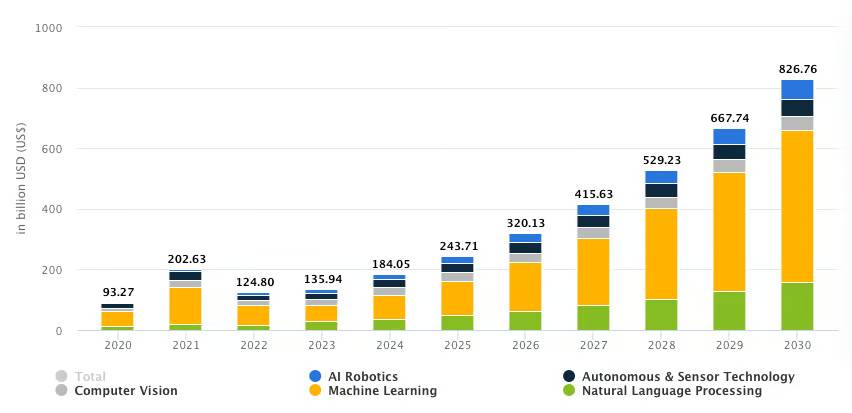
Statista's market research underscores this trend. They project the AI market will reach $320.13 billion USD by 2026 and $826.73 billion USD by 2030.
AI Jobs Come With Impressive Salaries
Naturally, skyrocketing demand for AI skills means substantial compensation. According to Glassdoor data from May 2026, the average salary for an AI engineer in the United States is $134,000 USD annually, plus bonuses and profit-sharing. Machine learning engineers and data scientists command comparable packages, averaging $124,000 and $150,000 respectively. These figures reflect the genuine value and impact that AI expertise brings to organizations.
AI is Intellectually Stimulating
Beyond the paychecks and job security, AI is simply fascinating work for people who love mental challenges. It involves building algorithms to solve genuinely complex problems, designing models that mirror human reasoning, and creatively applying these technologies to real-world scenarios.
AI professionals are constantly learning, adapting, and innovating. The field evolves relentlessly—there's always something new to discover, problems to crack, or systems to improve. This dynamic nature makes AI an exciting career path for people who thrive on continuous learning and intellectual growth.
How Long Does It Actually Take to Learn AI?
Timeline varies significantly depending on your learning path—self-study versus formal education like a university degree.
With self-directed learning, timelines can differ wildly since they depend heavily on your starting knowledge, dedication level, and available resources. You might spend anywhere from several months to a year or longer developing solid understanding of core AI concepts, Python, mathematics, and various machine learning algorithms through self-study. Online courses, tutorials, and hands-on projects can accelerate the process considerably.
Traditional university paths typically involve pursuing a formal degree in computer science, data science, or related fields. Bachelor's degrees usually take 3-4 years, during which students receive comprehensive training in AI and related disciplines.
Regardless of your chosen path, continuous learning, practical application, and staying current with new developments are essential for building a lasting AI career.
How to Learn AI from Scratch in 2026
Learning AI can be an exciting adventure, though it's definitely not without challenges. It's a vast field with deep, specialized topics. But with a clear roadmap, quality resources, and a strategic approach, you absolutely can master this field effectively. Here's how:
1. Master the Foundational Skills
Success in AI requires solid grounding in three core knowledge areas:
- Mathematics: AI relies heavily on mathematical concepts, especially in machine learning and deep learning. You don't need to be a mathematician to succeed with AI—particularly when using modern tools—but fundamental understanding of linear algebra, calculus, and probability is essential. Concepts like matrices and linear transformations come up constantly in AI algorithms.
- Statistics Fundamentals: AI becomes far more intuitive and meaningful when you understand statistics. The ability to interpret data and extract valuable insights is central to this field. Concepts like statistical significance, distributions, regression, and probability are critical across countless AI applications.
- Genuine Curiosity: AI evolves at breathtaking speed, with constant breakthroughs, new techniques, and emerging tools. A proactive mindset combined with genuine passion for learning and adaptability to new knowledge and technology is what separates practitioners who thrive from those who get left behind.
The depth of understanding you need in these foundational areas depends on your target role. A data scientist might not need deep mathematical knowledge of every concept used in AI, while a researcher developing new AI algorithms absolutely needs advanced mathematics proficiency.
The key is building a learning path aligned with your career goals and adjusting depth appropriately for each area.
Statistics
Statistics involves collecting, organizing, analyzing, interpreting, and presenting data. It's the foundational skill set for understanding and working with data in AI.
Mathematics
Certain math domains form the backbone of AI algorithms. Linear algebra, calculus, probability, and differential equations are mathematical tools you'll use throughout your AI learning journey.
2. Build Professional AI Skills
Once you've grasped foundational concepts, it's time to develop the specialized capabilities essential for AI mastery. Like foundational knowledge, the proficiency level needed depends on your target role.
Programming
Implementing AI demands solid programming fundamentals. Coding ability lets you develop AI algorithms, process data, and leverage AI tools and libraries. Python has become the dominant language in AI communities due to its clean syntax, flexibility, and rich ecosystem of data science libraries.
Data Structures
Data structures enable efficient storage, retrieval, and manipulation of information. Knowledge of arrays, trees, linked lists, and queues is essential for writing efficient code and developing complex AI algorithms.
Data Processing
Data processing includes cleaning, transforming, and manipulating data to prepare it for analysis or AI model training. Proficiency with libraries like pandas is crucial when working in AI.
Data Science
Data science combines multiple tools, algorithms, and machine learning principles to uncover hidden patterns in raw datasets. Understanding how to extract valuable insights from data is absolutely critical for AI professionals.
Prompt Engineering and Applied Machine Learning
Move beyond casual conversations. Learn systematic prompt experimentation, build retrieval pipelines, and understand how modern foundation models work so you can control them effectively.
Deep Learning
Deep Learning is a machine learning subfield that uses artificial neural networks with multiple layers to model and understand complex patterns in data. This technology underpins most cutting-edge AI applications today, from voice assistants to autonomous vehicles.
These skills interconnect closely, building comprehensive AI knowledge. An effective starting approach is mastering the fundamentals in each area before specializing in areas that interest you most. You can flexibly adjust your learning strategy based on your needs, focusing on emerging specializations as they surface through research and hands-on practice.
3. Learn Essential AI Tools and Libraries
Mastering appropriate tools and libraries is critical for AI success. Python and R have emerged as leading languages in AI communities for their simplicity, flexibility, and powerful libraries. While you don't necessarily need both for AI success, here are essential libraries and frameworks depending on which language you choose:
Top AI Tools and Libraries for Python
Python is a high-level interpreted programming language famous for readable syntax and flexibility. It's widely used in AI thanks to user-friendly code and extensive libraries and frameworks supporting data science.
pandas
pandas is a Python library offering comprehensive tools for data analysis. Data scientists use pandas for numerous tasks including data cleaning, transformation, and statistical analysis. It efficiently handles incomplete data, noisy data, and unlabeled data, making it invaluable for data preprocessing.
NumPy
NumPy (short for Numerical Python) supports large multidimensional arrays and matrices, plus a rich collection of advanced mathematical functions. It's fundamental for all scientific computing work, including AI applications.
Scikit-Learn
Scikit-Learn is a simple yet powerful tool for data mining and machine learning. Built on NumPy, SciPy, and matplotlib, it's open-source and completely free. The library provides diverse algorithms for classification, regression, clustering, and dimensionality reduction.
PyCaret
PyCaret is a powerful Python library that streamlines building and deploying AI models. It enables users to explore, preprocess, train, tune, and compare multiple machine learning algorithms efficiently with just a few lines of code.
PyTorch
PyTorch is an open-source machine learning library based on Torch. It's applied in natural language processing and artificial neural networks. Its greatest advantages are flexibility and speed, making it ideal for deep learning research.
Keras
Keras is a user-friendly artificial neural network library written in Python. It's designed to minimize time from concept to functional model, offering intuitive methods for building neural networks. Keras features a modular structure providing great flexibility when developing new models.
Commercial APIs
When ready for hands-on work, using APIs to access existing commercial models is one of the best starting approaches. Commercial APIs like OpenAI API and Anthropic API are excellent entry points.
Hugging Face
As your skills advance, explore pre-trained models via standard Python libraries like Hugging Face's `transformers` and `accelerate`—these libraries simplify GPU and TPU utilization.
LangChain
LangChain is currently one of the most popular AI frameworks, helping users integrate AI from large language models (LLMs) into data processing workflows and applications.
LLaMA
Llama (Large Language Model Meta AI) is an open-source large language model line developed by Meta (formerly Facebook). It provides a powerful alternative to proprietary models like GPT-5 and Claude Sonnet, allowing researchers and developers to fine-tune and deploy AI models efficiently.
- Best Free Online Courses for Learning AI
- Six Essential Steps to Begin Your AI Programming Journey
- Accredited Online AI Courses With Recognized Credentials
- Free Online AI Course from a Leading Finnish University
Description: Learn how to master AI from scratch in 2026. Expert tips, structured roadmap, essential tools, and why now is the perfect time to start your AI journe
Related Articles
- Hugging Face: The Python Ecosystem That Revolutionized AI Development
- How to Design Your Own Custom Sticker Pack with ChatGPT
- How AI Is Reshaping E-Commerce: From Tool to Team Member
- 8 Efficient AI Models That Run Smoothly on 8GB VRAM or Less
- Are AI Companions Really Dangerous? We Might Be Asking the Wrong Question

No Comment to " Getting Started with AI in 2026: A Beginner's Guide from Industry Experts "