DeepSeek V4 Complete Guide: Features, Performance Benchmarks, and Competitive Analysis
DeepSeek has finally delivered its highly anticipated V4 release, arriving right on the heels of OpenAI's GPT-5.5 and Anthropic's Claude Opus 4.7. The new lineup includes two preview models—V4-Pro and V4-Flash—both priced aggressively and delivering performance that's remarkably close to the frontier. What's interesting here is that DeepSeek is positioning these as serious alternatives, not just budget options.
The V4-Pro variant boasts 1.6 trillion total parameters with a default context window of 1 million tokens. DeepSeek claims it lags only 3 to 6 months behind the most advanced closed models while costing a fraction of what competitors like OpenAI and Anthropic charge.
This guide walks through the V4 release, examining key features, benchmark results, and direct comparisons with competing models.
Contents
What is DeepSeek V4?
DeepSeek V4 represents the long-awaited new open-weight large language model series from DeepSeek, the AI lab based in China. Launched on April 24, 2026, the V4 lineup comprises two models: DeepSeek-V4-Pro and DeepSeek-V4-Flash. Both leverage a Mixture of Experts (MoE) architecture and ship with a massive 1 million token context window by default.
What makes V4 significant for the industry is the combination of near-frontier performance with rock-bottom pricing. The V4-Pro model features 1.6 trillion total parameters (49 billion active parameters), making it the largest open-weight model available today.
Despite its size, DeepSeek maintains that it's only 3 to 6 months behind the most advanced closed models while carrying a price tag that's just a fraction of competitors like OpenAI and Anthropic. That's the real selling point.
Key Features of DeepSeek V4
Here's what stands out in this latest release:
Architecture Improvements and 1M Token Context Processing
The standout feature of DeepSeek V4 is how efficiently it handles extended context windows.
According to the technical notes, the V4 series uses a Hybrid Attention Architecture that combines Compressed Sparse Attention (CSA) with Heavily Compressed Attention (HCA).
Thanks to these structural enhancements, 1 million token context is now the standard across all DeepSeek services.
DeepSeek reports that in a 1 million token context scenario, DeepSeek-V4-Pro requires only 27% of the FLOPs for single-token inference and just 10% of the KV cache compared to its predecessor, DeepSeek-V3.2.
Three Reasoning Modes
To give users granular control over latency and performance, DeepSeek V4 includes three reasoning modes:
- Non-think: Fast, intuitive responses for everyday tasks and low-risk decisions.
- Think High: Conscious logical analysis that's slower but more accurate for solving complex problems.
- Think Max: Pushes reasoning to its absolute maximum to explore the model's capability ceiling.
Enhanced Agentic Capabilities
DeepSeek V4 is clearly optimized for agentic programming. The release notes indicate seamless integration with leading AI agents like Claude Code, OpenClaw, and OpenCode, while also powering DeepSeek's internal agentic programming infrastructure.
Advanced Training Optimization
Under the hood, DeepSeek introduced Manifold-Constrained Hyper-Connections (mHC) to strengthen residual connections and stabilize signal propagation. They also switched to the Muon Optimizer for faster convergence and better training stability, pre-training the models on over 32 trillion diverse tokens.
DeepSeek V4 Benchmarks
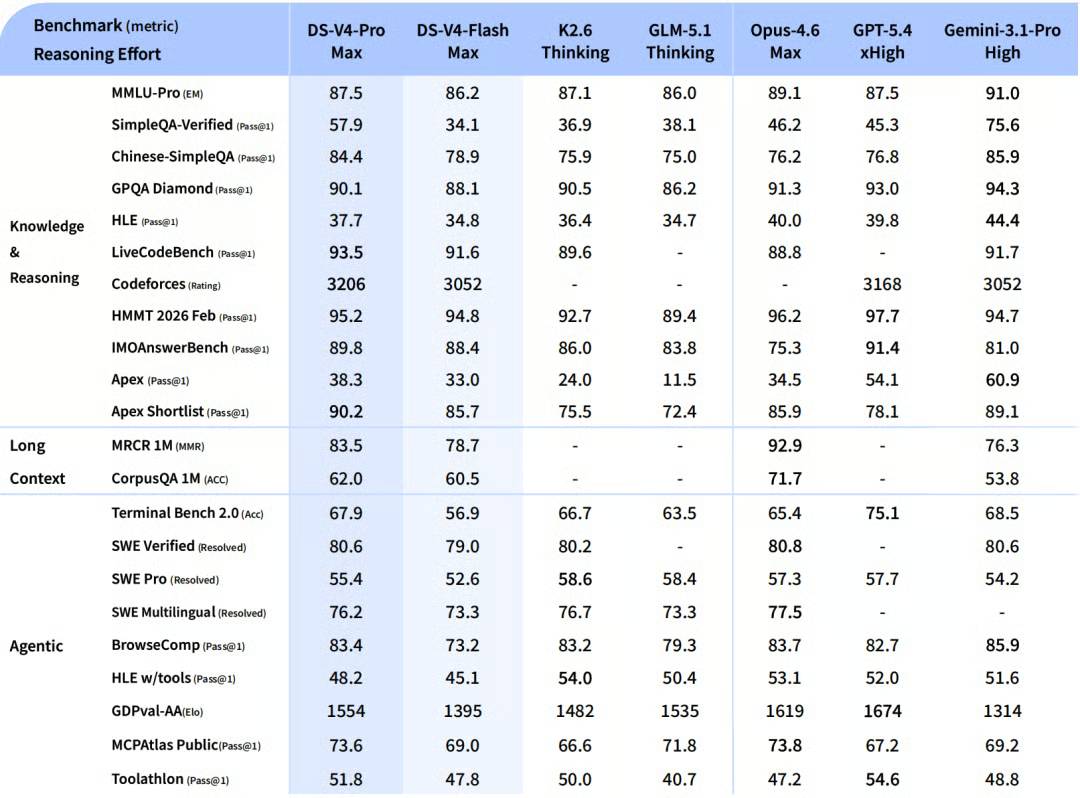
According to DeepSeek's internal results, V4 shows impressive performance, particularly when pushed to maximum reasoning limits (DeepSeek-V4-Pro-Max).
Here's how this model stacks up against general industry standards according to the official release notes:
Knowledge and Reasoning
Pro-Max easily outperforms other open-source models and beats older frontier models like GPT-5.2. It achieves a competitive 87.5% on MMLU-Pro and 90.1% on GPQA Diamond, plus 92.6% on GSM8K for mathematics. While still a few months behind the very latest frontier models (GPT-5.4 and Gemini-3.1-Pro), it's closed the knowledge gap considerably.
Agentic Tasks
Pro-Max matches top open-source models, scoring 67.9% on Terminal Bench 2.0 and 55.4% on SWE-Bench Pro. While it ranks slightly lower than the newest closed models on public leaderboards, internal testing suggests it outperforms Claude Sonnet 4.5 and is approaching the level of Opus 4.5.
Long Context
That 1 million token window isn't just for show. Pro-Max delivers exceptionally strong results here, achieving 83.5% on the "needle in a haystack" MRCR 1M (MMR) retrieval tests. This actually surpasses Gemini-3.1-Pro on academic long-context benchmarks.
DeepSeek V4 Pro vs Flash
Due to its smaller footprint, Flash-Max naturally scores lower on pure knowledge tasks and struggles with the most complex agent workflows. However, if you give it a larger "thinking budget," it achieves reasoning scores equivalent to more advanced models, making it an incredibly cost-effective choice for heavy workloads.
How to Access DeepSeek V4
Currently, there are several ways to access DeepSeek V4:
- Web Interface: Try both models immediately at chat.deepseek.com via Instant Mode or Expert Mode.
- API Access: The API is now available. Developers simply need to update their model parameters to deepseek-v4-pro or deepseek-v4-flash. The API maintains compatibility with both OpenAI ChatCompletions and Anthropic formats.
Note: The older deepseek-chat and deepseek-reasoner models will be discontinued on July 24, 2026.
- Open Weights: Both models are released under the MIT License. Download weights directly from Hugging Face or ModelScope. The Pro version requires 865GB, while the Flash version is a much more manageable 160GB.
DeepSeek V4 vs the Competition
We've recently seen OpenAI launch GPT-5.5 and Anthropic release Claude Opus 4.7. While these models possess leading-edge capabilities—particularly in long-context reasoning and agentic programming—DeepSeek V4 competes strongly on value and open accessibility.
Below is how DeepSeek-V4-Pro compares to the latest flagship models from OpenAI and Anthropic:
| Feature/Benchmark | DeepSeek V4 Pro | GPT-5.5 | Claude Opus 4.7 |
| API Pricing (Input/Output per 1M) | $1.74 / $3.48 | $5.00 / $30.00 | $5.00 / $25.00 |
| Context Window | 1M tokens | ~1M tokens | ~1M tokens |
| SWE-Bench Pro (Programming) | 55.4% | 58.6% | 64.3% |
| Terminal-Bench 2.0 (Agentic) | 67.9% | 82.7% | 69.4% |
| Open Weights | Yes (MIT License) | No (Closed Weights) | No (Closed Weights) |
Note: For budget-conscious users, DeepSeek V4 Flash costs just $0.14 per 1 million input tokens and $0.28 per 1 million output tokens—cheaper than even smaller models like GPT-5.4 Nano.
How Good is DeepSeek V4 Really?
DeepSeek V4 is a genuinely breakthrough release. According to DeepSeek's evaluation reports, the Pro model lags only 3 to 6 months behind the leading frontier models (like GPT-5.4 and Gemini-3.1-Pro) on the development roadmap.
But looking at the bigger picture of the industry, raw performance is only half the story. The real triumph of V4 lies in its exceptional context efficiency and absurdly low pricing.
Delivering near-frontier capabilities—including that 1 million token context window—at a cost that's just a fraction of GPT-5.5 or Opus 4.7, V4 is the most compelling choice for high-volume business tasks, open-source researchers, and developers working with tight budgets.
Real-World Use Cases for V4
Given these strengths, here are several areas where V4 excels:
- Automated Software Engineering: Strong agentic benchmarks and integration with tools like OpenClaw make V4-Pro an attractive candidate for automating codebase refactoring and debugging.
- High-Volume Document Processing: The reduced cost of handling 1 million token context means financial analysts and legal teams can process mountains of PDFs, 10-K reports, and contracts at minimal expense.
- Local Deployment and Research: Under the MIT License, researchers can quantize (particularly the 160GB Flash model) to run cutting-edge AI experiments locally on high-end consumer hardware.
Final Thoughts
DeepSeek V4 is a major step forward for the open-source AI community. While GPT-5.5 and Claude Opus 4.7 may edge ahead on the toughest programming and reasoning benchmarks, V4 has democratized access to 1 million token context windows and sophisticated agentic workflows. The real concern is whether this level of performance at this price point will reshape how organizations think about their AI infrastructure costs.
Frequently Asked Questions
Is DeepSeek V4 open source?
Yes. Both DeepSeek-V4-Pro and DeepSeek-V4-Flash are open-weight models released under the MIT License with very permissive terms. This allows developers and researchers to use, modify, and deploy these models for commercial purposes.
What's the context window size for DeepSeek V4?
Both the Pro and Flash versions come with a default 1 million token context window. Thanks to the new Hybrid Attention Architecture, DeepSeek V4 handles this enormous context with computational and memory costs that are only a fraction of older models.
How much does DeepSeek V4 API cost?
Pricing is extremely competitive. DeepSeek-V4-Flash runs just $0.14 per 1 million input tokens and $0.28 per 1 million output tokens. DeepSeek-V4-Pro costs $1.74 per 1 million input tokens and $3.48 per 1 million output tokens.
What are the model sizes for DeepSeek V4?
DeepSeek uses a Mixture of Experts architecture. The Pro model has 1.6 trillion total parameters (49 billion active) and requires an 865GB download. The Flash model has 284 billion parameters (13 billion active) and requires a 160GB download.
Does DeepSeek V4 beat GPT-5.5 and Claude Opus 4.7?
Not in pure capability terms. DeepSeek's own released data shows V4-Pro still trails the most advanced closed models by about 3 to 6 months on the toughest programming and reasoning benchmarks. However, it delivers near-frontier performance at roughly one-third the API cost, creating a powerful economic impact.
Description: Explore DeepSeek V4's capabilities, benchmark scores, and how it stacks up against GPT-5.5 and Claude Opus 4.7.
Related Articles
- Seedance 2.5 vs 2.0: What Actually Changed (Spoiler: Not What You Think)
- The Best AI Meeting Assistants: 5 Tools That Actually Save You Time
- How to Download and Export Your ChatGPT Conversations
- Windsurf vs Cursor: Which AI IDE Should You Choose?
- 10 Strategies to Future-Proof Your Career in the AI Era

No Comment to " DeepSeek V4 Complete Guide: Features, Performance Benchmarks, and Competitive Analysis "