4 Proven Strategies to Optimize Token Usage in Multi-Agent AI Systems
Building multi-agent AI systems introduces a deceptively simple problem: token consumption spirals out of control fast. When multiple AI agents coordinate to handle complex workflows, every component contributes to bloating the processing context—conversation history, memory buffers, system instructions, tool specifications, API parameters, you name it. The result? Slower inference, higher computational costs, and your LLM budget evaporating before you know it.
This is why token optimization has become essential knowledge for AI engineers. Here's the encouraging part: scaling a multi-agent system doesn't automatically mean costs scale proportionally. Apply the right architectural strategies, and you can build more capable systems while keeping expenses and latency under control. Below are four techniques that the industry relies on most.
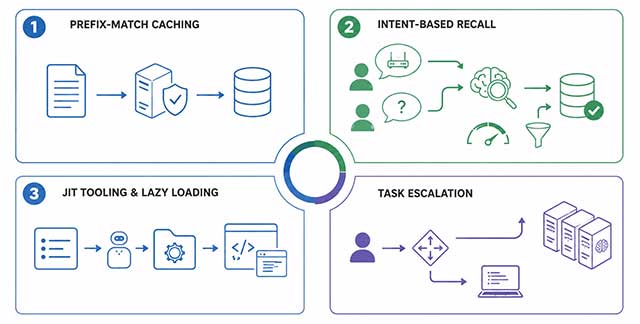
1. Static Instruction Caching (Prefix-Match Caching)
One major culprit behind token waste: LLMs repeatedly re-read identical system instructions on every single call. These are usually lengthy prompts describing the agent's role, processing workflows, tool usage rules, or security guidelines.
Static Instruction Caching solves this elegantly. Instead of loading these fixed instructions fresh each time, cache them once. The system then simply references the cached state and only processes the new prompt content.
Result? Context preparation time drops noticeably, and token throughput per inference call decreases. For agents with verbose system prompts, this technique alone can deliver massive efficiency gains with minimal implementation overhead.
2. Semantic Caching: Reusing Answers by Meaning
Think about it: if an AI has already solved a problem, why call the LLM again to regenerate the answer?
Semantic Caching operates on this principle. Rather than simple word-by-word matching, the system converts queries into vector embeddings and compares semantic similarity.
Consider these two questions:
- "How do I reset my router?"
- "What are the steps to restart my Wi-Fi modem?"
Different wording, identical intent. If their embeddings are similar enough, the system retrieves the cached answer without invoking the LLM again.
This dramatically cuts token costs and slashes response time for repeated or similar queries.
3. Just-in-Time Tooling
A common mistake: dumping the entire documentation for every tool, API, and database into the prompt upfront. This balloons the context window, introduces irrelevant information, and token counts spike immediately.
Just-in-Time Tooling (also called Lazy Loading) takes a smarter approach.
Instead of handing the agent a complete reference manual, give it only a brief summary of available capabilities. Load detailed tool specifications, parameters, and docs only when the agent decides it actually needs a specific tool.
Your prompt stays lean and focused on the current task.
4. Task Escalation (Model Routing)
Not every request deserves your most expensive model. In sophisticated multi-agent systems, a routing layer analyzes task complexity before deciding which model to use.
Simple tasks like:
- text summarization
- data formatting
- content classification
- intent detection
can run on lightweight local models or free alternatives.
Complex reasoning tasks requiring multi-step planning or agent orchestration? Those graduate to premium models.
This approach saves significant token spend while preserving output quality where it matters most.
Real Example: Combining Semantic Caching and Model Routing
Now let's see how Semantic Caching and Model Routing work together in practice.
This example uses Sentence Transformers to convert queries into embeddings for semantic caching. The LLM calls are simulated for clarity—you can swap them for open-source models like Llama via Ollama or Groq in production.
import numpy as np
from sentence_transformers import SentenceTransformer

# Loading a free, local model to convert text into embeddings
embedder = SentenceTransformer('all-MiniLM-L6-v2')

semantic_cache = {}
SIMILARITY_THRESHOLD = 0.90

def cosine_similarity(vec1, vec2):
    return np.dot(vec1, vec2) / (np.linalg.norm(vec1) * np.linalg.norm(vec2))

def route_and_respond(user_query):

    query_vector = embedder.encode(user_query)

    # Semantic Cache
    for cached_vector, past_response in semantic_cache.values():
        if cosine_similarity(query_vector, cached_vector) >= SIMILARITY_THRESHOLD:
            return f"[Served from Cache] {past_response}"

    # Model Routing
    if "summarize" in user_query.lower() or len(user_query) < 100:
        response = call_free_local_agent(user_query)
    else:
        response = call_heavy_reasoning_agent(user_query)

    semantic_cache[user_query] = (query_vector, response)

    return response

def call_free_local_agent(prompt):
    return "Action completed by local, zero-cost model."

def call_heavy_reasoning_agent(prompt):
    return "Action completed by complex orchestration agent."
Here's how the workflow unfolds:
First, the user's query gets converted to a vector embedding. Next, the system checks whether a semantically similar request has been processed before. If found, the cached result returns instantly—no LLM call needed.
If the cache misses, the system evaluates task complexity and selects an appropriate model. Simple requests run on a free local model; complex reasoning tasks route to a premium model.
Finally, the query and result get stored in semantic cache for future reuse.
Depending on task type, you'll see one of two outputs:
def call_free_local_agent(prompt):
    return "Action completed by local, zero-cost model."

def call_heavy_reasoning_agent(prompt):
    return "Action completed by complex orchestration agent."
This is an architectural illustration, but it demonstrates how combining semantic caching with model routing dramatically reduces calls to expensive LLMs.
Conclusion
Token optimization in multi-agent AI systems does more than cut costs—it improves response speed and system scalability across the board.
The four strategies—Static Instruction Caching, Semantic Caching, Just-in-Time Tooling, and Task Escalation (Model Routing)—are now standard practice in modern agent AI platforms. They trim unnecessary token consumption, minimize expensive model calls, and boost performance without sacrificing output quality.
Forward-thinking AI engineers focus less on selecting the most powerful model and more on intelligent system architecture and resource orchestration. Often, a well-designed multi-agent system outperforms a naive approach that throws a single large LLM at every problem.
Description: Learn how to build scalable multi-agent AI systems without exploding your LLM costs. Four practical optimization techniques explained.

No Comment to " 4 Proven Strategies to Optimize Token Usage in Multi-Agent AI Systems "